
-
×
 Lower KS2 Conjunctions Bundle
1 × £4.00
Lower KS2 Conjunctions Bundle
1 × £4.00 -
×
 Year 2 Subordinating Conjunctions Bundle
1 × £2.00
Year 2 Subordinating Conjunctions Bundle
1 × £2.00 -
×
Year 2 Expanded Noun Phrases Bundle
1 × £2.00
 Lower KS2 Conjunctions Bundle
  Year 2 Expanded Noun Phrases Bundle
 Grammar
Expanded Noun Phrases Explained
Expanded noun phrases – what are they and how do you teach them?
If you’re working through grammar in KS2, expanded noun phrases are one of those concepts that crop up early and keep coming back. They appear in the National Curriculum from Year 2 onwards, they’re tested in the KS2 SATs GPS paper, and they’re one of the most effective tools children have for improving the quality of their writing. So what exactly is an expanded noun phrase, and how do you help children use them well?
So, what is an expanded noun phrase?
A noun phrase is simply a noun and the words that go with it. An expanded noun phrase adds more detail to the noun by using modifiers – words or phrases that describe it more precisely. Those modifiers can come before the noun, after it, or both.
Here’s a simple example. Start with a basic noun phrase:
the dog
Now expand it:
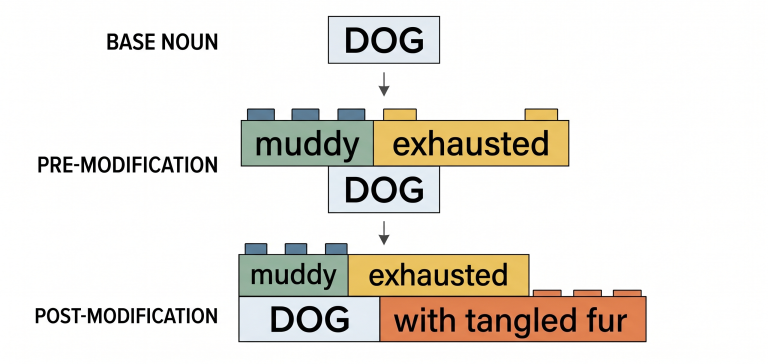
the muddy, exhausted dog
Or expand it further with detail after the noun too:
the muddy, exhausted dog with tangled fur
Each addition builds a clearer picture. That’s exactly what expanded noun phrases do – they give the reader more to work with, whether in a story, a description or a non-fiction text.
Why do expanded noun phrases matter in KS2?
Expanded noun phrases are introduced in Year 2 as part of the National Curriculum and children continue developing their use of them right through to Year 6. In the early years, the focus is on simple pre-modification – adding adjectives before the noun. By Upper KS2, children are expected to use post-modification too, adding prepositional phrases and relative clauses after the noun to build more sophisticated descriptions.
In the KS2 SATs GPS paper, expanded noun phrases appear in both identification questions and writing tasks. Children might be asked to tick the sentence that contains an expanded noun phrase, or to add a modifier to improve a given sentence.
Beyond the test, expanded noun phrases are one of the most accessible ways to lift the quality of children’s writing. A child who learns to build noun phrases confidently will naturally produce richer, more detailed descriptions – which is exactly what the KS2 writing assessment is looking for.
The two types of modifier
There are two main ways to expand a noun phrase, and children need to understand both.
Pre-modification (before the noun)
This is where modifiers come before the noun. In KS2, this usually means adjectives, though it can also include determiners including numbers.
the ancient, crumbling tower
three enormous grey elephants
a quiet, sunlit room
Pre-modification is usually the starting point for younger children in KS1 and Lower KS2. It’s intuitive – children naturally want to describe things before naming them.
Post-modification (after the noun)
This is where modifiers come after the noun, usually in the form of a prepositional phrase or a relative clause. Post-modification tends to appear in Upper KS2 and is a real marker of more sophisticated writing.
the tower at the edge of the cliff
the dog with tangled, muddy fur
the woman who lived in the old house on the hill
The most powerful expanded noun phrases combine both – modifiers before and after the noun together:
the ancient, crumbling tower at the edge of the cliff
the small, frightened rabbit with wide, unblinking eyes
When children start doing this naturally in their writing, it makes a real difference.
How to teach expanded noun phrases in KS2
1. Start with the noun, then build outwards
The clearest way to introduce expanded noun phrases is to start with a bare noun and add to it step by step.
Write a single noun on the board:
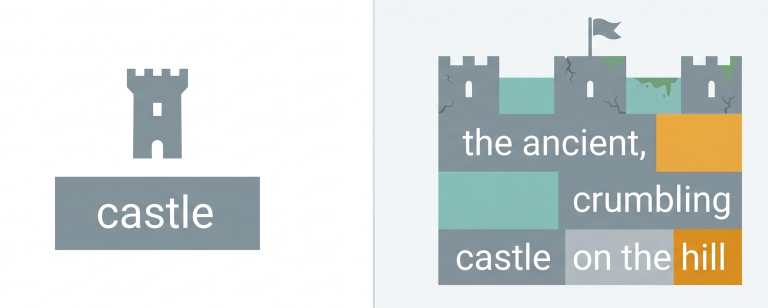
castle
Add a determiner:
the castle
Add an adjective:
the tall castle
Add another adjective:
the tall, crumbling castle
Add a post-modifier:
the tall, crumbling castle on the hill
Watching a phrase grow from one word to five or six makes the concept concrete and memorable. Children can then try building their own phrases from a noun you give them.
2. Use noun phrase pyramids
A simple visual activity that works well as a starter or a paired task. Draw a pyramid with the noun at the top, then add a layer for each modifier below it. Children work down the pyramid, expanding the phrase with each row. It slows the process down in a useful way – instead of rushing to a sentence, they focus on building the phrase carefully.
3. Improve the bland sentence
Give children a deliberately dull sentence and challenge them to improve only the noun phrases – nothing else.
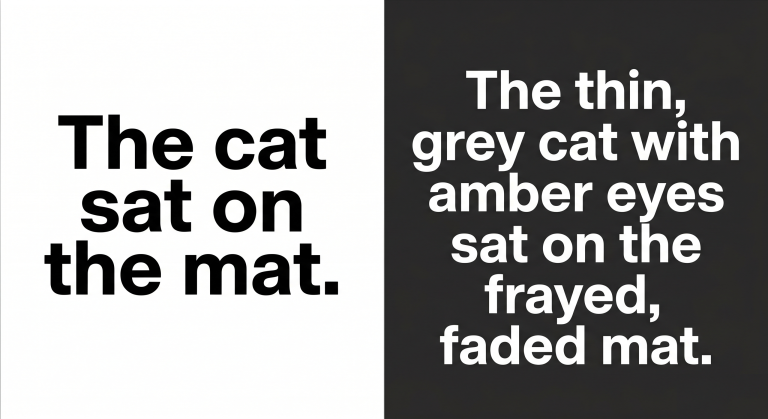
The cat sat on the mat.
Improved:
The thin, grey cat with amber eyes sat on the frayed, faded mat.
This constraint is important. By limiting children to improving the noun phrases only, you keep the focus sharp. Once they’ve done it a few times, they start to see how much heavy lifting the noun phrase does in a sentence.
4. Hunt for noun phrases in reading
Pause during guided reading or whole-class reading to spot expanded noun phrases in the text. Ask children to identify the noun, then pick out what comes before and after it. Good authors use noun phrases purposefully – finding them in real texts shows children that this isn’t just a grammar exercise, it’s something writers actually do.
Expanded noun phrase challenge
A quick activity that works as a starter, a plenary or a fast-finisher task. Give children a plain noun:
a tree
Challenge them to expand it as far as they can while still making sense:
a tall tree a tall oak tree covered in ivy a tall, ancient oak tree covered in thick, dark ivy at the far end of the field
Then ask: at what point does the expanded noun phrase become too much? This sparks a useful discussion about precision and restraint in writing – more words aren’t always better, but the right words always are.
Common mistakes to watch out for
Piling up adjectives without purpose. Once children discover they can add adjectives, some go overboard – the big, tall, enormous, gigantic castle isn’t expanded noun phrase writing, it’s repetition. Encourage children to choose the two or three most precise adjectives rather than listing everything they can think of.
Forgetting post-modification exists. Younger children often stick to pre-modification because it feels natural. From Year 4 onwards, push children to add a prepositional phrase or relative clause after the noun as well. The difference between the old dog and the old dog with cloudy eyes and a slow, heavy tread is significant.
Confusing expanded noun phrases with full sentences. An expanded noun phrase doesn’t have a verb – it’s a phrase, not a clause. The tall, crumbling castle on the hill is a noun phrase. The tall, crumbling castle on the hill stood alone is a sentence. This distinction matters in the GPS paper, where children may be asked to identify phrases vs. clauses.
Missing the comma between co-ordinated adjectives. When two or more adjectives modify the same noun and are interchangeable, they need a comma between them: a cold, dark night – not a cold dark night. A quick test: if you can put and between them and it still sounds natural, they need a comma.
Ready to teach expanded noun phrases with confidence?
If you’re looking for ready-made resources to support your expanded noun phrases teaching, our Expanded Noun Phrases Activity Pack has everything you need. It includes noun-building activities, sentence improvement tasks, and SPaG-style questions – all designed for KS2 and ready to use straight away.
Download the Expanded Noun Phrases Activity Pack →


Whether you’re introducing noun phrases for the first time in Year 2 or 3, or building on them ahead of SATs in Year 6, we hope this guide has given you a clear picture of what to teach and how. If you haven’t already, our fronted adverbials guide and subordinating conjunctions guide both pair well with this one – the three concepts often appear together in writing tasks and in the GPS paper. As always, if there’s a resource you’d like us to create, just let us know – we’re always adding to the collection.