
-
×
 Grammar Blast Bundle - Years 5 and 6
1 × £8.00
Grammar Blast Bundle - Years 5 and 6
1 × £8.00
Grammar, Resourcefully
10 Fun Ways to Teach Fronted Adverbials
Fronted adverbial activities that actually work in the classroom
If you’ve already introduced fronted adverbials and your class have got the basic idea, the next challenge is getting them to use them confidently and consistently in their own writing. That’s where these fronted adverbial activities come in. The good news is that fronted adverbials lend themselves to games, challenges and creative tasks in a way that a lot of grammar topics don’t. Here are ten ideas you can pick up and use straight away – most work across Years 3 to 6 with very little adaptation.
If you’re still at the introductory stage and want a clear explanation of what fronted adverbials are first, our fronted adverbials guide covers all the basics. Fronted adverbials are part of the KS2 National Curriculum from Year 4 onwards, so the earlier children build the habit, the better.
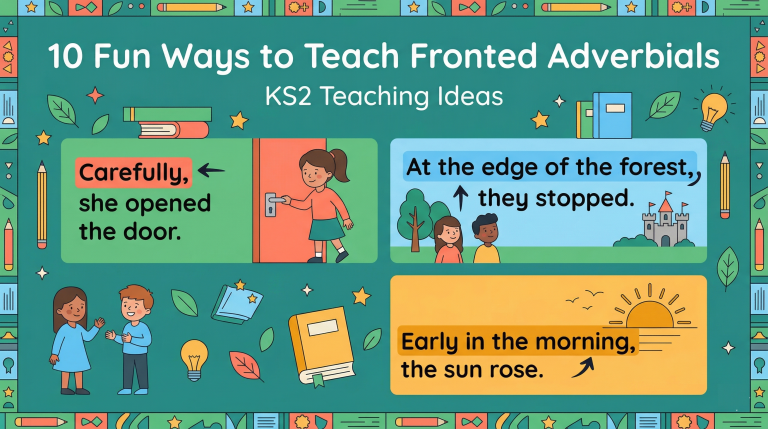
1. Sentence swap
This is the simplest starting point and it works at every ability level. Write a sentence on the board with the adverbial at the end:
The children ran across the playground.
Challenge the class to move the adverbial to the front:
Across the playground, the children ran.
Then do it again with a different sentence, and again. The repetition is the point – children need to see the swap happen several times before it starts to feel natural in their own writing. Once they’ve got it, pairs can write their own sentences for their partner to swap.
2. Fronted adverbial fortune tellers
Remember paper fortune tellers from the playground? They make a surprisingly effective grammar activity. Children write a different fronted adverbial on each flap – ‘Early in the morning, Without thinking, High above the clouds, As quiet as a mouse,’ – then swap with a partner, who opens the flap and has to write a sentence continuing from that opener. It gives the activity a game-like feel and means children produce sentences between them without it feeling like a worksheet.
3. Fronted adverbial opener of the day
Put a single fronted adverbial on the board at the start of every English lesson as a warm-up. This works particularly well in Year 3 and Year 4 when children are first building the habit:
Deep in the jungle, …
Children have two minutes to write as many sentences as they can that begin with it. Keep a running wall display of the best ones from across the week. After a few weeks you’ll have a rich bank of examples that children have actually written themselves, which is far more useful than anything you could put on a pre-prepared display.
4. Adverbial washing line
Write a set of fronted adverbials on cards and a set of main clauses on separate cards. Peg them onto a washing line (or lay them on tables) and ask children to mix and match them into complete sentences.
Without a sound, the cat crept under the bed.
Every single morning, the old man fed the birds.
In the distance, a light flickered in the window.
The physical act of moving the cards around helps children see that the fronted adverbial is a moveable part of the sentence, not fixed to a particular main clause.
5. Four-type challenge
Give children a plain sentence:
She walked into the room.
Challenge them to rewrite it four times – once with a fronted adverbial of time, once of place, once of manner, and once of frequency:
Late that evening, she walked into the room.
Inside the empty house, she walked into the room.
Slowly and carefully, she walked into the room.
Every night without fail, she walked into the room.
Each version creates a slightly different effect. Asking children to discuss which version they prefer and why turns a grammar exercise into a writing craft conversation.

6. Spot fronted adverbials in your reading
Pause during guided reading or shared reading and ask children to hunt for fronted adverbials in the text. Good authors use them intentionally – once children start looking, they find them everywhere. Ask children to note down the ones they spot in a reading journal and identify which type each one is. Over the course of a term this builds a personal bank of real examples they can draw on in their own writing.
7. Story opener relay
Split the class into groups of four. Each child writes one sentence beginning with a fronted adverbial, then passes the paper to the next person who has to continue the story with another fronted adverbial opener. This is a great Year 5 and Year 6 activity as it pushes children to use varied types rather than defaulting to the same opener. By the time the paper has gone round the group, they have the opening four sentences of a story – each one beginning with a different type of fronted adverbial.
High on the cliff, a lighthouse stood alone.
In the howling wind, a door began to creak.
Suddenly, the light went out.
Without a second thought, Maya stepped inside.
Reading these aloud at the end is always satisfying – the fronted adverbials create real pace and atmosphere, which makes the grammar feel purposeful rather than mechanical.
8. Upgrade the bland sentence with fronted adverbials
This works well as a starter or a fast-finisher task. Give children a deliberately flat, boring paragraph – the kind of writing you might see in a weak GPS response – and ask them to upgrade it by adding fronted adverbials.
Before: The dog ran. It was raining. Tom called the dog. The dog came back.
After: Across the wet grass, the dog ran. In the pouring rain, Tom stood and called. Eventually, the dog came back.
Seeing the before and after side by side makes the impact of fronted adverbials immediately obvious. Children who struggle to generate their own fronted adverbials often find it easier to spot where one would fit in an existing piece of writing first.
9. Fronted adverbial dice
Make or print a set of dice (or use an online dice roller) with a different fronted adverbial category on each face: time, place, manner, frequency, and two wild cards. Children roll the dice and have to write a sentence using a fronted adverbial of that type. Roll again, write another sentence – and keep going until they have six sentences that could form the opening of a story. The randomness of the dice means children can’t default to the same opener every time.
10. The comma audit
Once children are writing fronted adverbials regularly in their independent work – typically from Year 5 onwards – give them a piece of their own writing – or a short piece you’ve prepared – and ask them to go through it with a coloured pen and circle every fronted adverbial they can find. Then check: does each one have a comma after it? This self-editing habit is one of the most transferable skills you can build, and it directly supports GPS paper performance.
A good extension is to ask children to check whether they’ve used all four types in a single piece. If they’ve used three time adverbials and nothing else, challenge them to swap one for a fronted adverbial of manner or place.
Which activity should you start with?
For Lower KS2 (Years 3 and 4), sentence swap and opener of the day are the best entry points – both are low-stakes and high-repetition, which is exactly what children need when they’re first internalising the concept.
For Upper KS2 (Years 5 and 6), the four-type challenge, story opener relay and comma audit all work well as they push children toward deliberate, varied use rather than just mechanical application.
Ready to save some planning time?
If you want ready-made fronted adverbial resources to support these activities, our Year 4 Fronted Adverbials Pack has identification tasks, sentence writing activities and GPS-style questions.




For more on the topic itself, our fronted adverbials guide and subordinating conjunctions guide both pair well with these activities – the three concepts reinforce each other once children are working at sentence level with confidence. As always, if there’s a resource you’d like us to create, just let us know – we’re always adding to the collection.
