
Topics
Anglo-Saxon Crime and Punishment KS2 (Facts + Teaching Ideas)
Crime and punishment is one of the most engaging parts of the Anglo-Saxon topic – and one of the most revealing. The way a society decides what counts as a crime, who gets punished, and how, tells you an enormous amount about its values, its power structures, and what it was trying to protect. Anglo-Saxon England is no exception.
This post covers the key facts your class needs to know about Anglo-Saxon crime and punishment, structured around the KS2 History National Curriculum – specifically the “Viking and Anglo-Saxon struggle for the Kingdom of England” programme of study, which includes Anglo-Saxon laws and justice. Subject knowledge draws on Anglo-Saxon law (Wikipedia), Britannica’s overview of Anglo-Saxon law, and the Reading Museum’s Anglo-Saxon fact sheet.
It also includes a section on Helmstan – a real Anglo-Saxon criminal whose case is documented in an actual historical source – and some practical ideas for getting the most out of this topic in the classroom.
How Anglo-Saxon law worked
The Anglo-Saxon legal system looks very different from our own, but it wasn’t arbitrary. It was built around a few core principles: community responsibility, compensation over punishment, and the central importance of a person’s word.
There were no police, and no prisons in the punitive sense – nobody was sentenced to “two years in jail.” Basic gaols existed to hold suspects until a king’s representative arrived to hear their case, but imprisonment wasn’t a punishment in itself. Keeping order was largely the responsibility of the community, through a system called the tithing – a group of around ten men who were collectively responsible for each other’s behaviour. If one member of a tithing committed a crime and wasn’t caught, the whole group could be held liable.
When a crime was committed, the victim was expected to raise the hue and cry – literally a loud shout calling for help. Every able-bodied person who heard it was legally required to stop what they were doing and join the chase. Ignoring the hue and cry was itself a crime. It’s one of those details children find immediately vivid – the idea that the whole village was obligated to sprint after a thief – and it works well as a drama or role-play starter.
Cases were heard in local courts. The most important of these was the hundred court, which met regularly to deal with disputes and crimes within its area. More serious cases could be escalated to the shire court, presided over by the king’s representative.
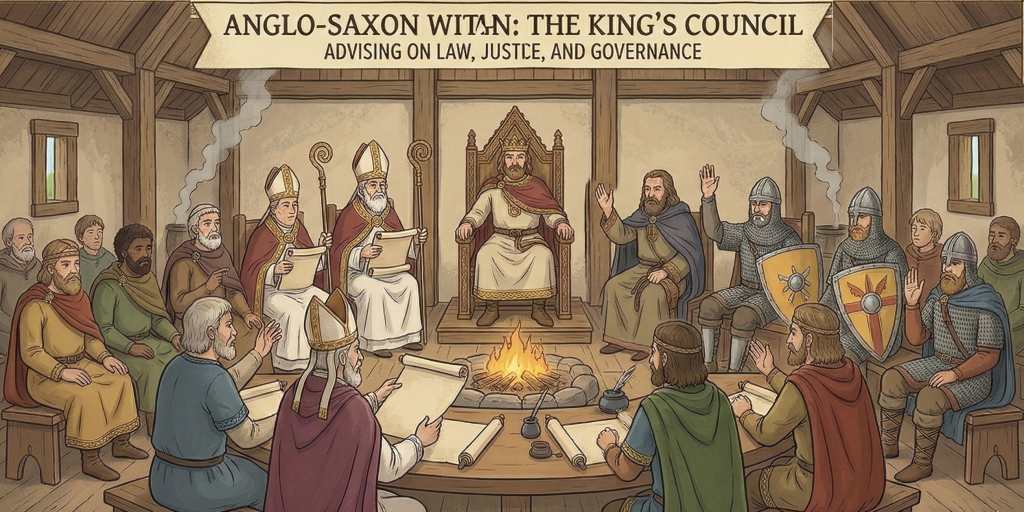
According to Britannica, Anglo-Saxon law was made up of three elements: laws enacted by kings with the advice of their witan (council), statements of established custom, and private legal compilations. The primary focus was criminal law – what counted as a crime, who owed what to whom, and how disputes should be resolved.
Wergild: putting a price on a person
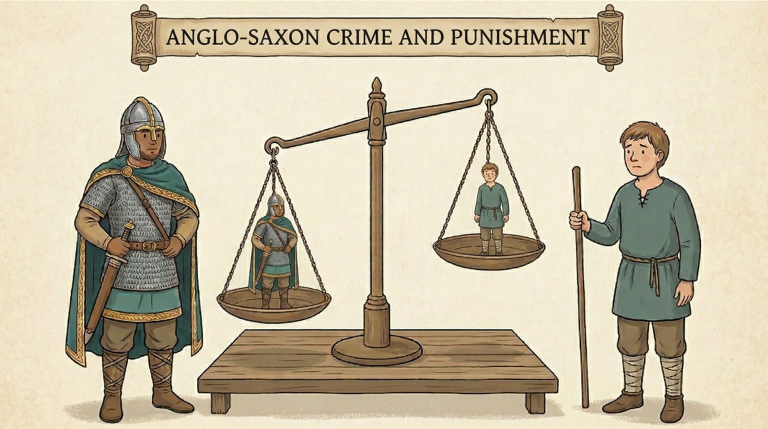
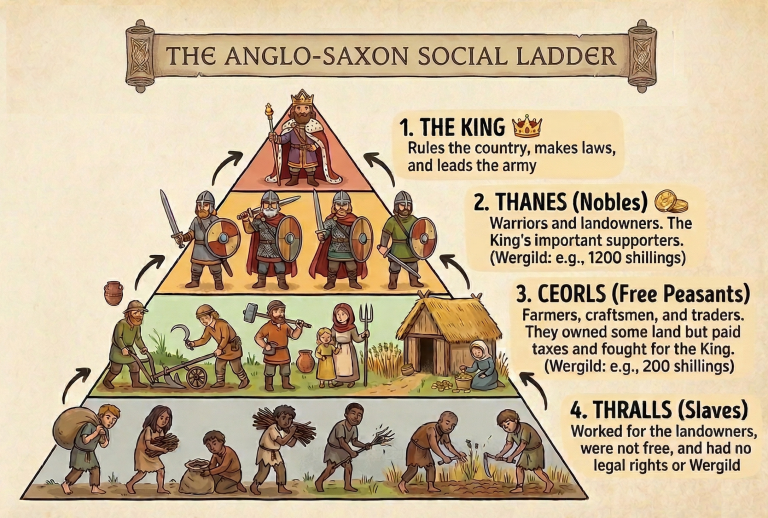
The cornerstone of Anglo-Saxon criminal justice was wergild – literally “man payment” or “blood price.” If you killed someone, you owed their family a set amount of compensation. The amount wasn’t fixed – it depended entirely on the status of the victim.
A thegn (nobleman) was worth 1,200 shillings. A ceorl (free peasant) was worth 200 shillings. A thrall (enslaved person) had no wergild at all – they had no legal standing and could not claim compensation. These are the standard West Saxon (Wessex) values that appear most commonly in textbooks and are the right ones to use with your class, though it’s worth knowing that values varied between kingdoms and across different centuries.
The wergild system replaced the older tradition of the blood feud – where a murdered person’s family were expected to take revenge on the killer’s family directly. Wergild was intended to break that cycle by substituting payment for violence. Anglo-Saxon law codes set out the criteria for legitimate blood feuds where wergild wasn’t paid, but the clear direction of travel was toward monetary compensation and away from private vengeance.
Children tend to have strong reactions to wergild. Was it fair? Does assigning different values to different people’s lives make the system more or less just than one that treats everyone equally? These are exactly the kinds of historically grounded ethical discussions the National Curriculum asks KS2 children to have.
Proving guilt: oaths, oath-helpers and trial by ordeal
Without a police force or forensic evidence, proving guilt was genuinely difficult. Anglo-Saxon law had two main mechanisms.
Trial by oath was the most common. A defendant swore an oath of innocence – and crucially, they needed others to swear alongside them. These oath-helpers (sometimes called compurgators) weren’t witnesses to the crime. They were community members prepared to stake their own reputation on the defendant’s honesty. The number of oath-helpers required depended on the seriousness of the charge and the defendant’s social status.
This system had an obvious weakness: if you were powerful or well-connected, gathering oath-helpers was easy. If you were poor, a stranger, or had a bad reputation in the community, it was much harder – even if you were innocent. According to Wikipedia’s overview of Anglo-Saxon law, if a defendant’s community believed him to be generally untrustworthy, he would be unable to gather oath-helpers and would lose his case regardless of the facts.
When oath-taking failed – either because the defendant couldn’t gather enough supporters, or because the community simply didn’t believe them – the case might proceed to trial by ordeal. The most common forms were:
- Trial by hot iron: the accused carried a red-hot iron bar for nine paces. The wound was bandaged and inspected three days later. If it was healing cleanly, they were innocent. If it had become infected, they were guilty.
- Trial by hot water: the accused plunged their hand into boiling water to retrieve an object. The same healing test applied.
- Trial by cold water: the accused was bound and thrown into blessed water. The logic is counter-intuitive and worth explaining to children explicitly: water was considered a pure element, so it would only “receive” (swallow) someone who was also pure – meaning innocent. Sinking meant innocence; floating meant the water had rejected them, which meant guilt. Children almost always assume it’s the other way around, so it’s worth pausing on this.
Ordeals were always conducted in a church context and overseen by a priest. The underlying belief was that God would intervene to protect the innocent – making the outcome, in theory, divine rather than arbitrary. Trial by ordeal was eventually abolished by the Church in 1215 at the Fourth Lateran Council, on the grounds that it amounted to “tempting God” – a useful endpoint for children to know, and one that prompts the question of what replaced it.
Common crimes and their punishments
Anglo-Saxon law recognised a broad range of crimes. Theft was among the most common and most serious – partly because in a subsistence farming society, stolen livestock or grain could mean genuine hardship for a family.
A first-time offender might be ordered to pay compensation to the victim plus a fine to the king. Repeat offenders faced progressively harsher physical punishments: mutilation was common, including the cutting off of a hand, foot, nose or ear. This served a dual purpose – it punished the criminal and marked them permanently, acting as a visible deterrent to others.
The most serious crimes – treason against the king, betraying a lord, or murder without payment of wergild – could carry the death penalty. Execution methods included hanging and beheading.
One punishment worth discussing with children is outlawry. An outlaw wasn’t simply someone who had broken the law – they were someone who had been cast outside its protection entirely. An outlaw could be killed by anyone without legal consequence, because they had forfeited their right to the law’s shelter. The word “outlaw” still carries that meaning today, though we tend to use it more loosely.
Sanctuary offered a counterbalance. A person fleeing justice could take refuge in a church and claim sanctuary – a period of protection during which they couldn’t be dragged out and punished. This gave even the most desperate criminal a temporary breathing space, and reflects the significant role the Church played in the justice system by this period.
Helmstan: a real Anglo-Saxon criminal
One of the most remarkable things about studying Anglo-Saxon crime and punishment is that we have real cases – not invented examples, but actual documented incidents from historical sources.
Helmstan is one of them. His story comes from the Fonthill Letter, a document written during the reign of King Edward the Elder (AD 899-924), and one of the most detailed legal records to survive from the period. According to Wikipedia’s account of Anglo-Saxon law, Helmstan was a cattle thief who was scratched in the face by a bramble while fleeing the scene of his crime. When his case came to court, that scratch was produced as physical evidence against him.
Crucially, this wasn’t his first offence. Helmstan was a repeat criminal who had previously lost his land as a punishment for theft. That context matters for the classroom discussion: should someone who has already been punished once receive a second chance, particularly when that chance depends on having a powerful friend to speak for them?
What makes the Helmstan case particularly interesting for teaching is what it reveals about how the system actually worked in practice – not just in theory. He had a patron, a nobleman called Ordlaf, who supported him despite his guilt. The letter hints at the way that personal loyalty, social connections and the exchange of favours could bend the formal mechanisms of the law. Power mattered, even in a system built around oaths and community responsibility.
For children, the Helmstan case raises questions that still feel relevant: Does everyone get the same justice? What happens when powerful people protect guilty ones? Is a scratch on the face really enough evidence to convict someone?
Was the Anglo-Saxon justice system fair?
This is the question worth sitting with at the end of the topic – and there’s no clean answer, which is exactly what makes it valuable.
The wergild system had genuine logic to it. It attempted to replace cycles of violence with structured compensation, and it gave victims’ families a concrete remedy rather than just grief. The tithing system created collective accountability that, in close-knit communities, probably worked reasonably well.
But the system also encoded inequality directly into law. The higher your status, the more your life was worth. The better your community connections, the easier it was to prove your innocence. A thrall had no protection at all. Trial by ordeal placed enormous faith in divine intervention in situations where the evidence was inconclusive – which is to say, precisely when careful judgment was most needed.
Children who engage seriously with these questions are doing exactly what the National Curriculum asks of them: thinking about similarity and difference across time, asking whether things have changed for better or worse, and developing their own historically informed judgements.
Teaching ideas for this topic in the classroom
Vocabulary matching activity: Give children a set of terms (wergild, tithing, hue and cry, ordeal, oath-helper, outlaw, sanctuary, thegn, ceorl) with definitions to match. Works well as a starter before moving into the main content.
Hue and cry role-play: One child plays the victim who raises the hue and cry; the rest of the class must immediately join the chase. Simple, physical and memorable – and it makes the concept of collective legal responsibility genuinely stick.
The Helmstan discussion: Present the key facts of Helmstan’s case to children and ask them to consider the evidence. Is a bramble scratch enough to convict someone? What else would they want to know? This works as a guided discussion or a written task.
Put the system on trial: Split the class into groups representing different members of Anglo-Saxon society – a thegn, a ceorl, a thrall, a priest. Ask each group to assess how well the justice system serves their character. Whose interests does it protect? Whose does it ignore?
Then and now: Ask children to identify three ways the Anglo-Saxon justice system is different from our own, and one way it might be similar. This comparison task builds the kind of chronological perspective the curriculum asks for.
The ethics debate: Was it ever fair to assign different wergilds to different people? Give children a structured argument frame and ask them to write a justified opinion. Good for linking history to PSHE and moral reasoning.
National Curriculum alignment
This post covers the following statutory content from the KS2 History National Curriculum:
- The Viking and Anglo-Saxon struggle for the Kingdom of England: Anglo-Saxon laws and justice
- Historical concepts: continuity and change, cause and consequence, similarity and difference, significance
- Historical enquiry: understanding how evidence is used to make historical claims
Ready to teach this topic?
If you’re looking for a fully resourced lesson on Anglo-Saxon crime and punishment – including a vocabulary matching activity, the Helmstan case study, and a structured ethics discussion – it’s all in our Anglo-Saxon Planning Unit. Ten lessons, two enquiry questions, everything you need to pick up and teach. Two sample lessons are available free before you buy.
You might also find these posts in the cluster useful:
- Anglo-Saxon Facts for KS2 (What Children Need to Know) – the essential overview

Key Stage 2


Key Stage 2
Further reading for teachers
- Anglo-Saxon law – Wikipedia
- Anglo-Saxon law – Britannica
- Reading Museum: Anglo-Saxon crime and punishment fact sheet
- National Curriculum in England: History programmes of study
