Topics
Anglo-Saxon Vocabulary for KS2 | Key Words + Meanings
Teaching Anglo-Saxons in KS2 means teaching a lot of new words. Thane, fyrd, wergild, witan – children need these to make sense of Anglo-Saxon society, and they need them explained clearly before any deeper learning can stick. This guide covers the key vocabulary children are likely to encounter, grouped by theme so you can introduce it in the order that suits your unit.
Law and order
Anglo-Saxon law was practical and community-based. A lot of vocabulary in this area links directly to how crimes were dealt with and how justice was carried out.
Wergild – Literally “man price.” This was a system of compensation where if you killed or injured someone, you (or your family) paid a fine to the victim’s family. The amount depended on the victim’s rank – killing a thane cost much more than killing a churl. Thralls had no wergild at all. The system was designed to prevent facility feuds spiralling out of control.
Hue and cry – The obligation on any witness to a crime to raise an immediate alarm and join the pursuit of the criminal. If you saw a theft and didn’t shout, you could be punished yourself. The whole community was expected to give chase. It’s a practical extension of the collective responsibility principle – law enforcement wasn’t a job for specialists, it was everyone’s duty.
Trial by ordeal – A method of determining guilt where the accused was subjected to a painful physical test – carrying red-hot iron, plunging a hand into boiling water, or being thrown into water. If they recovered or survived, they were considered innocent. It was believed God would protect the innocent.
Oath-swearing – Accused people could sometimes call on others to swear an oath on their behalf, vouching for their character. These supporters were called oath-helpers or compurgators. The more oath-helpers you could gather, the more credible your case.
Outlaw – Someone who was expelled from society as punishment for serious crimes. An outlaw lost all legal protection. Anyone could kill an outlaw without penalty, and no one was obliged to help them.
Warfare and defence
Fyrd – The Anglo-Saxon army, made up of ordinary freemen called to fight. Every able-bodied free man could be summoned to serve in the fyrd. By the time of Alfred the Great, the fyrd was organised more formally, with half on active duty while the other half stayed home to farm.
Housecarl – A professional soldier who served the king or a senior nobleman full-time. Unlike the fyrd, housecarls were trained warriors who provided the core fighting force. The term came into use particularly under the Danish king Cnut.
Shield wall – The main Anglo-Saxon battle formation. Warriors stood side by side with overlapping shields, forming a solid defensive wall. The Battle of Hastings in 1066 saw the famous English shield wall eventually broken by the Normans.
Burh – A fortified settlement or town. Alfred the Great built a network of burhs across Wessex as part of his defence against the Vikings, positioned so that no settlement was more than a day’s march from one. Over time, many burhs grew into the first real market towns – people felt safe enough behind the walls to trade, and permanent settlements followed. Several modern English towns sit on the footprint of an Anglo-Saxon burh.
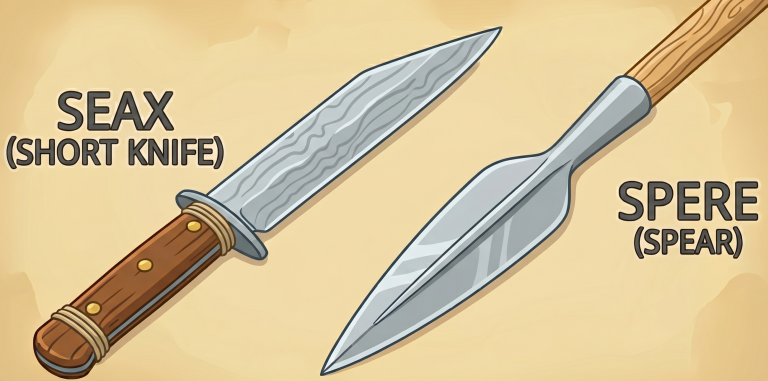
Seax – A short knife carried by almost everyone, regardless of social rank. The word is where the “Saxon” in Anglo-Saxon comes from. The seax was used for everything – eating, woodworking, farming – and in combat. Finding a seax in an excavated grave tells archaeologists very little about the person’s status, because everyone had one.
Spere (spear) – The most common weapon in Anglo-Saxon England. By law, every freeman was expected to own one. It was also the sacred weapon of the god Woden, which gave it significance beyond its practical use.
Sweord (sword) – Extremely expensive to make and a clear marker of high social status. A sword required a skilled smith and considerable resources. Most ordinary warriors would never own one – finding a sword in a burial site tells us a great deal about who was buried there.
Religion and belief
Pagan – The term used for the early Anglo-Saxon religious beliefs before Christianity arrived. Anglo-Saxons worshipped a pantheon of gods, and their names have survived in the most unexpected place – our days of the week. Tuesday comes from Tiw, the god of war. Wednesday from Woden, the chief god and protector of warriors. Thursday from Thunor (the Anglo-Saxon equivalent of Thor), god of thunder. Friday from Frige, goddess of love and the home. Saturday is the odd one out – it keeps its Roman origin (Saturn’s Day), with no Anglo-Saxon substitution. Even the word Easter comes from Eostre, the goddess of spring. Children often find this genuinely surprising, which makes it one of the most effective vocabulary hooks in the whole unit.
Monastery – A religious community of monks. After the conversion to Christianity, monasteries became centres of learning, manuscript production and community life. Lindisfarne, founded in 635 AD, is one of the most famous.
Monk – A man who lived in a monastery and devoted his life to religious practice and study. Many monks were scribes who copied and illuminated manuscripts, preserving knowledge that might otherwise have been lost.
Manuscript – A handwritten book or document. Before printing, all books were copied by hand, usually by monks. The Lindisfarne Gospels is one of the finest surviving Anglo-Saxon manuscripts.
Conversion – The process by which the Anglo-Saxons shifted from pagan beliefs to Christianity, beginning in 597 AD when Pope Gregory sent Augustine to England. The conversion happened gradually over about a century.
Everyday life
Mead hall – The large communal building at the centre of Anglo-Saxon settlement life. This was where the lord feasted with his followers, where stories were told, gifts were given and bonds of loyalty were strengthened. The mead hall from the poem Beowulf – Heorot – is the most famous example in English literature.
Mead – An alcoholic drink made from fermented honey. It was the drink of the Anglo-Saxon nobility, shared in the mead hall as part of feasting and celebration.
Scop – A poet and storyteller (pronounced “shop”). The scop was an important figure in Anglo-Saxon society, responsible for composing and performing epic poetry that preserved history, celebrated victories and reinforced the values of the community. They were effectively the living memory of the tribe.
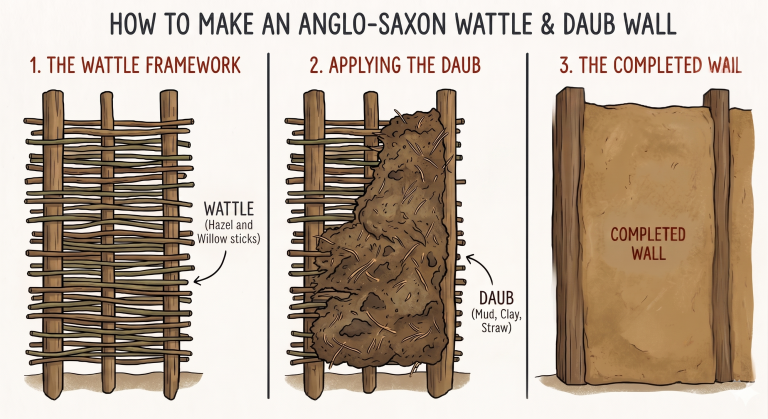
Wattle and daub – The main building material used in Anglo-Saxon construction. Wooden strips (wattle) were woven together and then covered with a mixture of mud, clay and straw (daub) to form walls. Most Anglo-Saxon homes were built this way.
Shire – An administrative area of land, roughly equivalent to a county. England was divided into shires, each overseen by an ealdorman and managed by a reeve.
Society and social structure
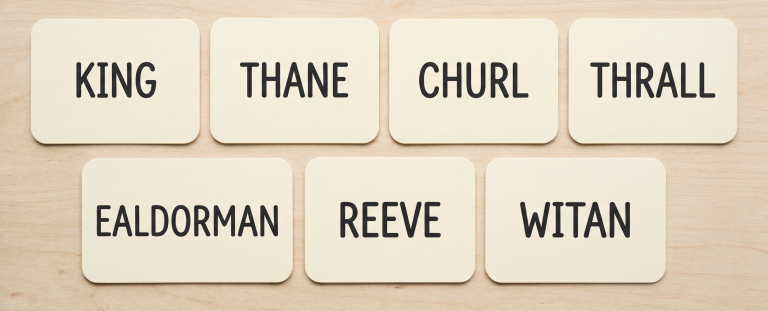
The Anglo-Saxons had a clearly defined social structure, and understanding the different roles depends entirely on knowing the vocabulary.
King – The ruler of an Anglo-Saxon kingdom. England was divided into several kingdoms, each with its own king – Northumbria, Mercia, Wessex, East Anglia and others. By the 9th century, Wessex had become the dominant kingdom.
Thane (also spelled thegn) – A nobleman who held land granted by the king. Thanes sat near the top of Anglo-Saxon society, below the king and his earls. They were expected to serve in battle and support the king. The word literally means “one who serves.”
Churl – A free peasant farmer. Churls made up the majority of Anglo-Saxon society. They owned or rented land and owed labour and military service. Over time, many churls became increasingly tied to the lords above them.
Thrall – A slave. Thralls had no legal rights and no wergild (see below). They could be bought and sold, and their lives were entirely controlled by their owner.
Ealdorman – A senior nobleman who governed a region on behalf of the king. Think of them as regional governors. The word later evolved into “earl.”
Reeve – An official who helped the ealdorman manage an area, collecting taxes and enforcing order. The term “shire-reeve” is where the word sheriff comes from.
Witan – Short for Witenagemot, this was the king’s council – a group of senior nobles, bishops and thanes who advised the king and could influence major decisions, including who became the next king. The king wasn’t obliged to follow their advice, but ignoring it entirely was usually a poor move. It’s the earliest ancestor of what eventually became Parliament.
Anglo-Saxon place names
One of the best vocabulary hooks in this topic is right outside the school window. Thousands of place names across England are Anglo-Saxon in origin, and teaching children to decode the suffixes turns a map into a historical document.
-ing means “people of” or “tribe of.” Reading comes from Readingas – “Redda’s people.”
-ton means a farm or farming village. Preston, Luton, Taunton.
-ham means a village or homestead. Birmingham, Chippenham, Nottingham.
-bury means a fortified place. Shaftesbury, Newbury, Canterbury.
-wich / -wick means a farm or trading place. Norwich, Woolwich, Ipswich.
-chester marks a settlement with Roman roots, from the Latin castra (fort). Manchester, Winchester, Colchester.
Birmingham is a particularly useful example because it layers several elements together: Beorma (a chieftain’s name) + ing (his people) + ham (their village). “Beorma’s people’s village.” Later names often shifted to describing the landscape rather than the people – Oxford simply means a shallow river crossing where oxen could ford the water.
If you’re based in the north of England, many local place names will also show Viking influence (-by, -thorpe, -thwaite), which can prompt a useful discussion about who settled where and when.
A challenge activity for the classroom
Give children a set of these vocabulary words and definitions to match up, then ask them to choose three and write a sentence using each one in context. For older or more able children, challenge them to use two vocabulary words in a single sentence: The thane paid a wergild to the churl’s family after the dispute.
For a quicker starter activity, try this Old English word match. These Anglo-Saxon words are remarkably close to their modern equivalents – children usually spot the connections faster than they expect:
| Anglo-Saxon | Modern English |
|---|---|
| Modor | Mother |
| Faeder | Father |
| Brothor | Brother |
| Hund | Dog |
| Wudu | Wood |
| Scild | Shield |
| Swurd | Sword |
| Brid | Bird |
It’s a simple activity but it makes a strong point: the language the Anglo-Saxons spoke never really disappeared. It just changed shape.
Common mistakes children make with Anglo-Saxon vocabulary
Mixing up thane and thrall is very common – they’re both T words and children often confuse the two despite the fact they sit at opposite ends of the social ladder. A quick visual of the social hierarchy with the labels helps anchor these.
Children also tend to assume “outlaw” just means a criminal. It’s worth spelling out that the Anglo-Saxon term meant something very specific – a person literally outside the protection of the law, not just someone who broke it.
Wergild is usually fine once children grasp the “man price” translation, but some will assume it only applied to murder. It covered a range of injuries too, with a detailed schedule of payments depending on which body part was harmed.
Conflating Anglo-Saxons and Vikings is extremely common, and understandable – they overlapped in time and both left a deep mark on England. The key distinction is that the Anglo-Saxons were the settlers who farmed, built kingdoms and developed English law and culture, while the Vikings (initially) were raiders from Scandinavia. The housecarl and the burh are actually Anglo-Saxon responses to the Viking threat, which is a useful way to keep the two groups distinct in children’s minds. The Danelaw complicates this later – by the 9th century, Vikings were settling too – but at KS2 level, the defender/raider distinction is a solid starting point.
Ready to teach Anglo-Saxons?
Our Anglo-Saxon Planning Unit includes display-ready vocabulary resources, lesson plans and activities covering society, crime and punishment, religion and everyday life – all written for KS2 and ready to use.
Explore the Anglo-Saxon Planning Unit →


Key Stage 2


Key Stage 2


Key Stage 2

Key Stage 2
For more on this topic, take a look at our Anglo-Saxon Facts for KS2 guide and our post on Anglo-Saxon Crime and Punishment.