
 Coordinating Conjunctions Bundle | Year 2 | KS1 | and, but, or
 Grammar
What are Coordinating Conjunctions? (KS2 Guide)
Coordinating conjunctions – what are they and how do you teach them?
Conjunctions are one of the first grammar topics children meet in KS2, and coordinating conjunctions are usually the starting point. They’re the small joining words that hold sentences together – and while they might seem simple on the surface, there’s more to teach here than just FANBOYS. This guide covers what coordinating conjunctions are, how they differ from subordinating conjunctions, and some practical ways to get children using them confidently in their writing.
So, what is a coordinating conjunction?
A coordinating conjunction joins two main clauses of equal weight. Both clauses can stand alone as complete sentences – the conjunction simply connects them.
Here’s a simple example:
She was tired. She kept going.
Join them with a coordinating conjunction:
She was tired but she kept going.
The word but is the coordinating conjunction. It links the two clauses without making either one depend on the other. Remove it, and both halves still make sense as sentences. That equality is what makes it coordinating.
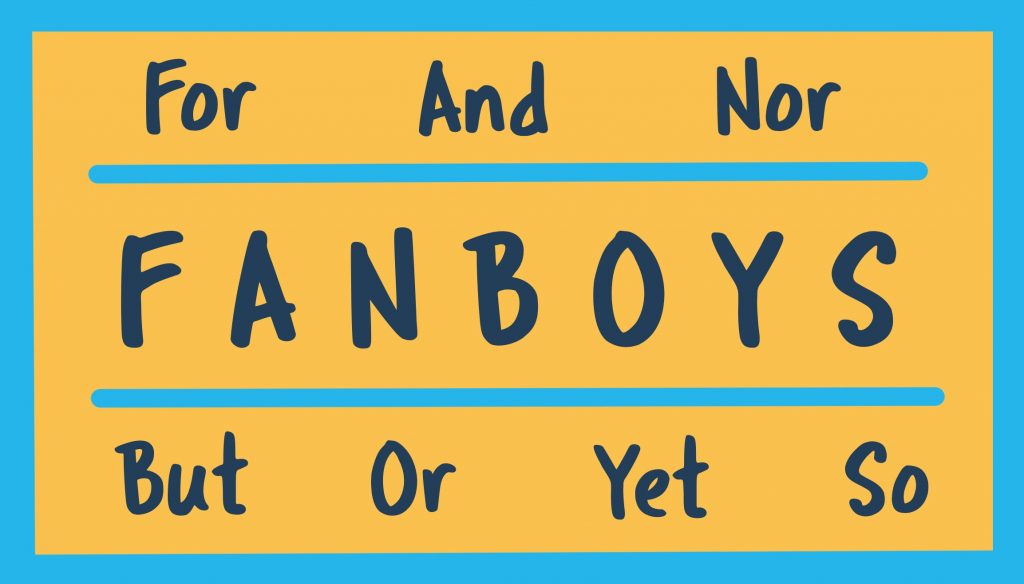
The coordinating conjunctions: FANBOYS
There are seven coordinating conjunctions in English, and the easiest way to remember them is the mnemonic FANBOYS:
F – for A – and N – nor B – but O – or Y – yet S – so
Each one shows a slightly different relationship between the two clauses:
for- shows reason (formal, rarely used in speech): He stayed inside, for it was bitterly cold.
and – adds information: She packed her bag and she left.
nor – joins two negative clauses: She didn’t call nor did she write.
but – shows contrast: It was raining but they went outside.
or – shows a choice: You can work quietly or you can move to another table.
yet – shows contrast (similar to but, slightly more formal): The test was hard yet she finished first.
so– shows a result: He missed breakfast so he was hungry by nine.
In practice, children in KS2 will use and, but, or and so most frequently. Yet, for and nor are worth teaching in Upper KS2 as ways to add variety and formality to writing.
Coordinating conjunctions vs. subordinating conjunctions
This is the distinction children most often muddle, and it’s worth being very clear about. If you’ve already covered subordinating conjunctions, this comparison will help consolidate both concepts.
Coordinating conjunctions join two clauses of equal weight. Both clauses make sense on their own.
She was tired but she kept going. (Remove but: She was tired. / She kept going. Both work.)
Subordinating conjunctions join a main clause to a subordinate clause. The subordinate clause depends on the main clause and can’t stand alone.
She kept going although she was tired. (Remove although: She kept going. Works. / Although she was tired. Doesn’t work on its own.)
The simplest test is to remove the conjunction and split the sentence in two. If both halves make sense as complete sentences, the conjunction is coordinating. If one half falls apart, it’s subordinating.
Why do coordinating conjunctions matter in KS2?
Coordinating conjunctions are part of the KS2 National Curriculum from Year 3 onwards, where children are expected to use them to join clauses and extend their sentences. By Year 6, children need to be able to identify them in GPS paper questions and use them alongside subordinating conjunctions to vary their sentence structure.
Beyond the test, coordinating conjunctions are one of the most practical tools children have for moving away from short, choppy sentences. A child who has only and in their toolkit will overuse it. Teaching the full range — and crucially, teaching when but, so or yet would work better — makes a visible difference to the quality of independent writing.
How to teach coordinating conjunctions in KS2
1. Start with the FANBOYS mnemonic
The mnemonic is a genuinely useful teaching tool because it gives children a complete list they can check against. Introduce it early and refer back to it regularly. A classroom display or bookmark with FANBOYS on it means children can self-check whether the conjunction they’ve chosen is coordinating or subordinating without having to ask.
Once children know the list, focus on meaning. The seven conjunctions aren’t interchangeable – and and but do very different things. A quick activity is to give children a sentence and ask them to complete it with each FANBOYS conjunction in turn, noticing how the meaning shifts each time:
She opened the door …
and a cold wind rushed in. but nobody was there. or she would be late. so she could see who was knocking. yet she hesitated.
Comparing the versions as a class makes the differences concrete.
2. Teach the comma rule for coordinating conjunctions
When a coordinating conjunction joins two main clauses, a comma before the conjunction is optional in British English – but it becomes important when the clauses are long, or when leaving it out makes the sentence harder to read.
It was a cold morning and the children were wrapped in their coats. (comma optional) It was bitterly cold outside, and the heating had broken down overnight. (comma helpful)
This is subtly different from the rule for subordinating conjunctions, where the comma appears when the subordinate clause moves to the front of the sentence. Worth flagging the difference explicitly in Upper KS2 so children don’t apply one rule everywhere.
3. Sentence combining
Give children two short sentences and ask them to join them using the most appropriate FANBOYS conjunction. The key word is most appropriate – there will often be more than one option that works grammatically, but only one or two that make logical sense.
Tom forgot his homework. He was nervous about telling the teacher.
Possible combinations:
Tom forgot his homework and he was nervous about telling the teacher. (adds information, but loses the cause-and-effect)
Tom forgot his homework so he was nervous about telling the teacher. (shows result – strongest option here)
Tom forgot his homework but he told the teacher anyway. (different meaning, but valid)
Discussing which version works best – and why – is where the real learning happens.
4. Upgrade the and-heavy paragraph
Once children know the full FANBOYS list, give them a piece of writing that’s overloaded with and and ask them to replace as many as possible with a more precise conjunction. This is a common issue in Year 3 and Year 4 writing, and fixing it makes an immediate difference.
Before: We went to the park and it was sunny and we played football and I scored a goal and we had ice cream.
After: We went to the park because it was sunny. We played football, and I scored a goal. Afterwards we had ice cream, so it was a brilliant afternoon.
The after version uses a mix of sentence types rather than just replacing every and with a FANBOYS word – but the exercise opens up that conversation naturally.
5. FANBOYS sorting activity
Write a set of sentences on cards, each using a different coordinating conjunction. Children sort them into groups by the relationship the conjunction shows: adding information, showing contrast, showing a result, showing a choice. This builds understanding that the seven words aren’t just a list to memorise – they each do a specific job.
Common mistakes to watch out for
Starting a sentence with a coordinating conjunction. Children are often told never to start a sentence with and or but, but this isn’t a grammar rule – it’s a style guideline, and published authors break it regularly for effect. The important thing is that it’s a deliberate choice, not a habit born from not knowing how to join clauses. In formal writing and GPS paper responses, it’s safer to avoid it; in creative writing, starting with But or And can create real impact.
Overusing and. This is by far the most common issue in Lower KS2 writing. Children default to and because they know it works. Exposing them to the full FANBOYS list early – and giving them specific reasons to choose but, so or or instead – is the most effective fix.
Confusing yet with and yet. Yet as a coordinating conjunction means roughly the same as but – it shows contrast. And yetis a two-word phrase that does the same job. Children sometimes mix these up or treat yet as an adverb (meaning still or so far). Context usually makes it clear, but it’s worth flagging.
Confusing coordinating with subordinating conjunctions. Children who know FANBOYS and also know the subordinating conjunction list will occasionally misidentify one as the other. The split-sentence test (does each half stand alone?) is the most reliable way to check.
Ready to teach coordinating conjunctions with confidence?
If you’re looking for ready-made resources to support your conjunctions teaching, our Lower KS2 Conjunctions Bundlecovers both coordinating and subordinating conjunctions with activities, display materials and GPS-style questions.



For the full picture on conjunctions in KS2, this post pairs directly with our subordinating conjunctions guide – between the two posts you’ll have everything you need to teach both types with confidence. As always, if there’s a resource you’d like us to create, just let us know – we’re always adding to the collection.
