
Topics
What is the Sutton Hoo Treasure? (KS2 Guide)
Few archaeological discoveries have changed the way we understand a period of history quite as dramatically as Sutton Hoo. Before 1939, the Anglo-Saxon period was widely dismissed as a dark age – a gap between the sophistication of Roman Britain and the medieval world that followed. What was unearthed in a Suffolk field that summer made that view impossible to hold.
This post covers what Sutton Hoo is, what was found there, what the treasure tells us about the Anglo-Saxons, and why the mystery at the heart of it – there was no body – makes it one of the most compelling historical detective puzzles you can bring into a KS2 classroom.
The content is structured around the KS2 History National Curriculum, specifically the programme of study for Britain’s settlement by Anglo-Saxons, which includes Anglo-Saxon art and culture. Sources include the British Museum’s Sutton Hoo collection, the National Trust’s history of the site, and Britannica’s overview of Sutton Hoo.
What is Sutton Hoo?
Sutton Hoo is an archaeological site near Woodbridge in Suffolk, England. It contains two Anglo-Saxon cemeteries dating from the 6th and 7th centuries, visible today as a series of low grassy mounds on a hillside overlooking the River Deben.
The name comes from Old English: sut and tun together mean “southern settlement,” and hoo means a hill shaped like a heel spur. It’s worth pointing out to children that even the name of the site is Anglo-Saxon – another example of how their language is still with us today.
The site is now managed by the National Trust, and most of the original treasures are held in the British Museum’s Room 41 in London.
The discovery: Edith Pretty and Basil Brown
In 1939, Edith Pretty – a landowner and lifelong history enthusiast – became curious about the group of mounds on her estate at Sutton Hoo. She had noticed them for years and wondered what lay beneath them. She commissioned a local self-taught archaeologist named Basil Brown to investigate.
Brown had already explored some of the smaller mounds in 1938, finding fragments of cremated bone and some corroded metal objects. In the summer of 1939, he turned his attention to the largest mound – Mound 1 – and began carefully removing the sandy soil layer by layer.
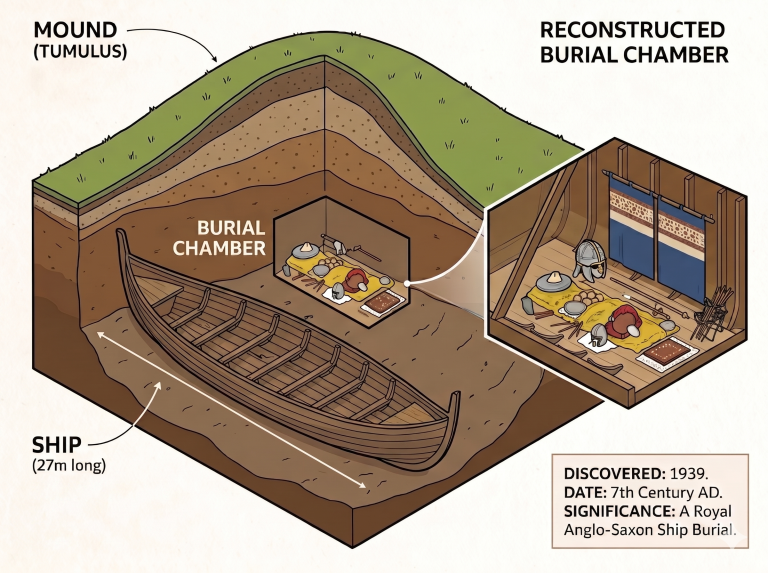
What he found stopped him in his tracks. The outline of a ship began to emerge from the earth. Not the ship itself – the wood had long since rotted away – but its ghostly impression in the soil, held together by the original iron rivets still suspended in the sand in their original rows. It was the pattern of those rivets, perfectly preserved, that told Brown he was looking at a ship rather than a burial mound like the others. The ship was 27 metres long.
As the excavation progressed, a burial chamber emerged at the centre of the ship. Inside was one of the most extraordinary collections of objects ever found in British soil. According to the National Trust, the discovery revolutionised the understanding of early England – a time that had been seen as backwards was suddenly revealed as cultured and sophisticated.
When it became clear how significant the find was, a team of national experts took over from Brown – a decision that has attracted criticism from historians who felt he deserved more credit.
At the end of the dig, Edith Pretty made a remarkable decision. An inquest ruled that the treasure belonged to her as the landowner – but she donated all 263 objects to the British Museum, so that everyone could benefit from the discovery. When the Second World War broke out weeks later, the treasures were packed away and stored for safekeeping in a disused section of the London Underground – specifically Aldwych station, where they sat alongside the Rosetta Stone.
What was found in the burial chamber?
The burial chamber at Sutton Hoo contained an astonishing range of objects – weapons, feasting equipment, jewellery, coins, and imported goods from as far away as the Byzantine Empire and the Middle East.
The helmet is the most famous object from the site and one of the most recognisable images of the Anglo-Saxon period. Made of iron with decorative panels, a face mask, and intricate interlaced patterns, it would have been an extraordinary object even when new. When found, it had corroded and shattered into more than 500 fragments after the burial chamber collapsed – conservators at the British Museum faced the task of piecing together a 500-piece three-dimensional puzzle, and it took many years to reconstruct. There are only four complete Anglo-Saxon helmets known to survive from this period.
Look closely at the helmet’s design and a hidden image emerges: the nose piece forms the body of a dragon, the eyebrows its outstretched wings, and the moustache its tail. Where the dragon’s head meets another serpentine figure rising from the crest of the helmet, the two creatures appear to be locked together. It’s a detail children find genuinely exciting once they see it – and it’s a good reminder that Anglo-Saxon art often rewards a closer look. The helmet wasn’t just protective armour; it was a statement of power and identity.
Weapons and armour included a sword with a jewelled pommel, a shield decorated with animal figures, and a set of spears. These were ceremonial in quality – far too fine for battlefield use – and signal that whoever was buried here was of the highest status.
Feasting equipment included a large cauldron, drinking horns mounted with silver, and a set of Byzantine silver bowls. The presence of drinking vessels and feasting equipment reflects what we know from Anglo-Saxon literature – the mead hall, where a lord feasted his warriors and rewarded loyalty, was central to Anglo-Saxon culture. Beowulf is full of exactly these scenes.
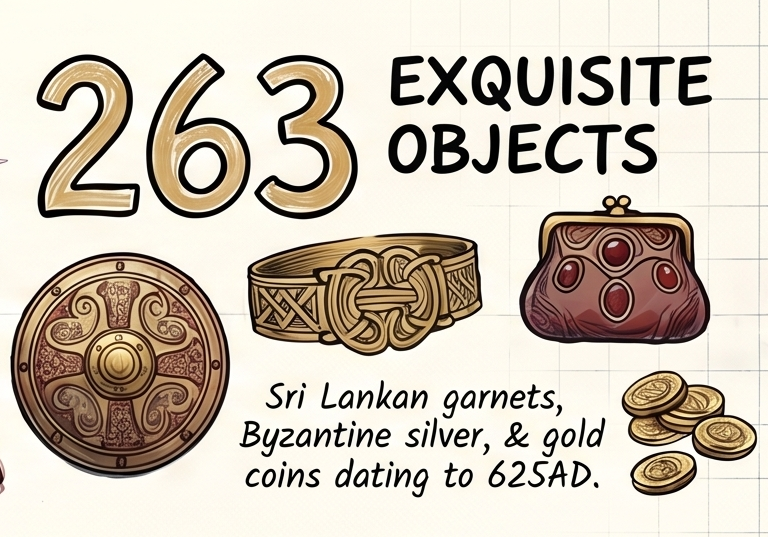
The purse lid is a masterpiece of Anglo-Saxon craftsmanship: a hinged lid decorated with intricate gold and garnet cloisonné work, containing 37 gold coins. The coins are significant – they have been dated to around AD 625, which helps fix the probable date of the burial.
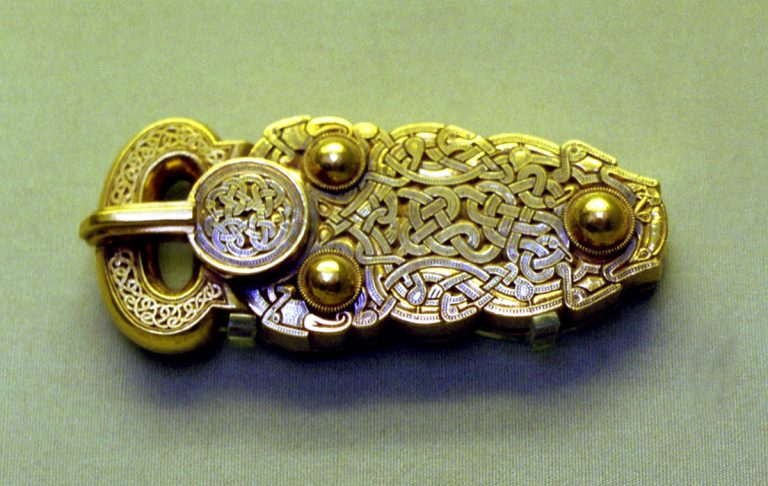
Imported objects show just how connected the Anglo-Saxon world was. A silver dish bears a stamp of the Byzantine Emperor Anastasius I (who reigned from AD 491 to 518). Silver spoons are inscribed in Greek. A bronze bowl came from the Middle East. The deep red garnets set into the gold jewellery and the helmet’s decorative panels are thought to have originated in Sri Lanka or India. Gold shoulder clasps were modelled on the ceremonial dress of Roman emperors, suggesting the king was deliberately associating himself with the prestige of the fallen empire. According to Britannica, these items together demonstrate that the Anglo-Saxons had far-reaching trade contacts – hardly the picture of an isolated, backward people.
The sceptre – a decorated whetstone topped with a bronze stag – is thought to be a symbol of royal authority. Nothing quite like it has been found anywhere else.
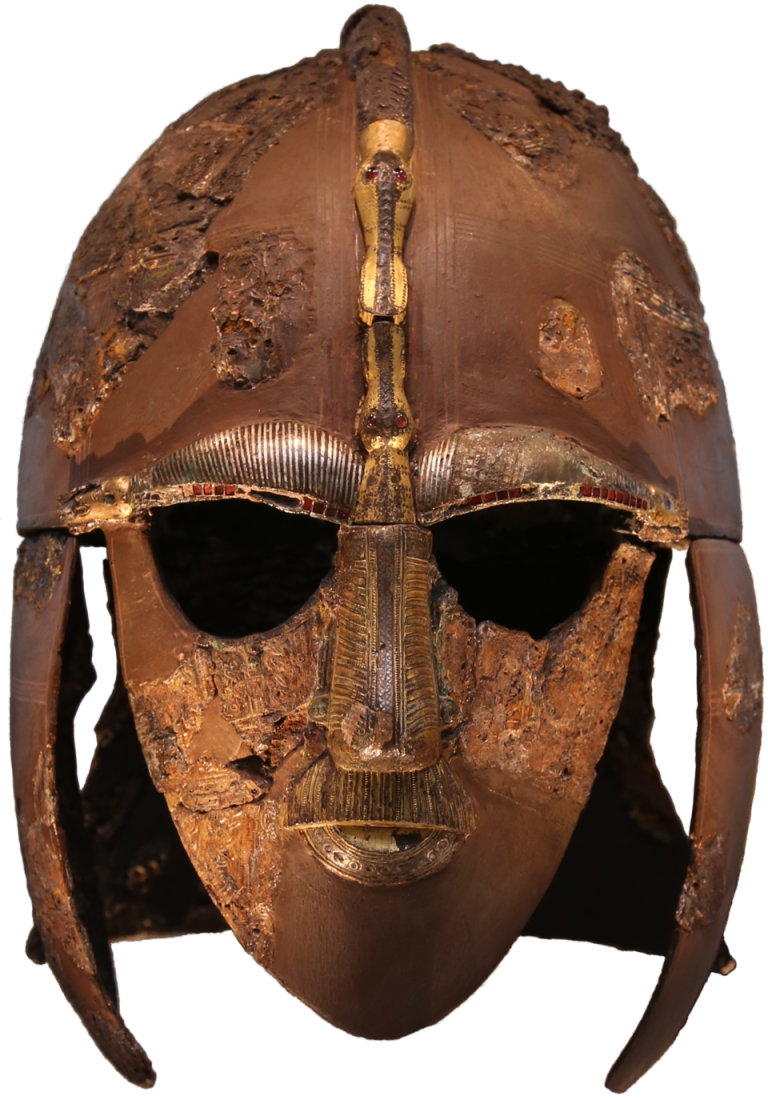
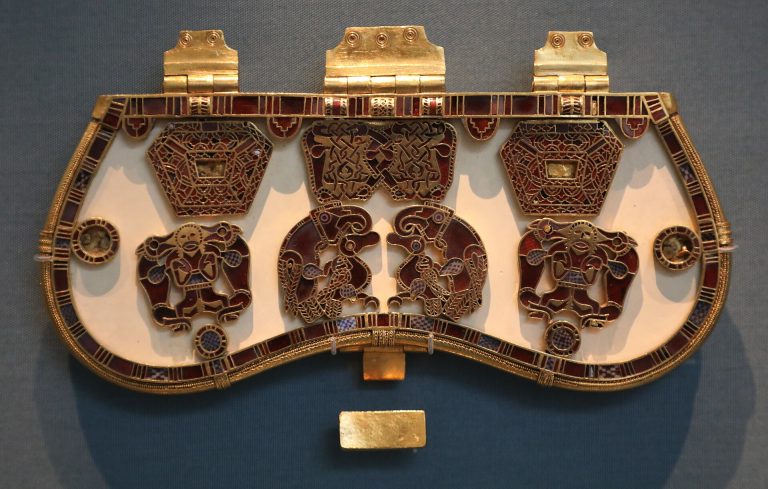
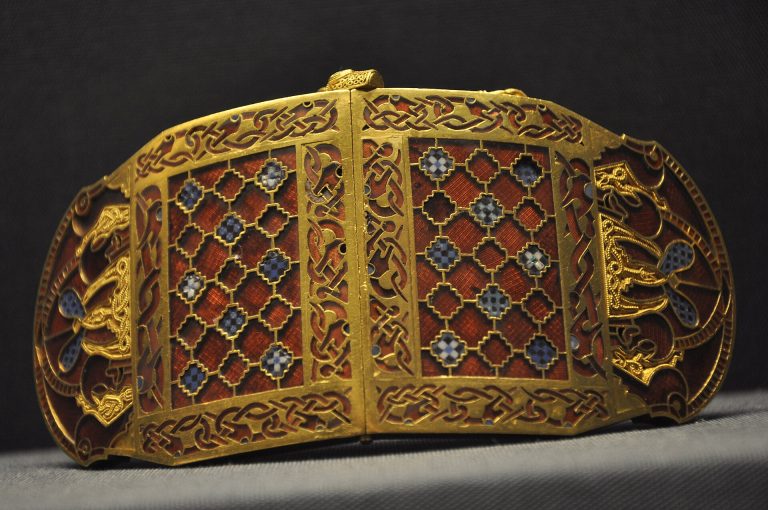
Sutton Hoo helmet, photograph by Geni, CC BY-SA 4.0, via Wikimedia Commons.
Sutton Hoo buckle, photograph by Ken Eckert, CC BY-SA 4.0, via Wikimedia Commons.
Sutton Hoo purse, photograph by Geni, CC BY-SA 4.0, via Wikimedia Commons.
Sutton Hoo schliesse, photograph by Aiwok, CC BY-SA 3.0, via Wikimedia Commons.
The mystery: where is the body?
Here is the question that makes Sutton Hoo irresistible as a teaching topic: there was no body.
When archaeologists first excavated the burial chamber, they found no trace of human remains. For years some historians suggested it might be a cenotaph – a memorial burial containing no body at all. But follow-up excavations between 1965 and 1971 settled the question. Chemical analysis of the sand beneath the chamber revealed unusually high levels of phosphate – the residue left by dissolved human remains. A body had been there. The acidic, sandy Suffolk soil had simply dissolved it completely over 1,300 years, leaving nothing behind but a chemical trace in the ground. It’s a remarkable fact in itself, and one children find genuinely surprising: science can detect the ghost of a person who left no bones.
So who was it?
The leading theory, supported by most historians, is that the burial belongs to King Rædwald of East Anglia, who is thought to have died sometime before AD 627. The coins found in the purse lid date to around AD 625 – they tell us the earliest possible date the burial could have taken place, not the exact date. Historical dating from this period is always an estimate, and AD 625 fits comfortably within the timeframe of Rædwald’s death, making the identification plausible without being provable.
The monk Bede, writing in the early 8th century in his Ecclesiastical History of the English People, describes Rædwald as the most powerful king among the English kingdoms south of the Humber – making him a plausible candidate for a burial of this scale and richness.
Several details make the Rædwald theory particularly compelling. The sceptre suggests a king of unusual authority. Rædwald belonged to the Wuffing dynasty, who claimed descent from Woden – the chief Anglo-Saxon god – giving the burial a dynastic significance beyond just one man’s death. And the grave goods contain a striking mixture of Christian objects (the Greek spoons, inscribed with the names Saul and Paul, suggesting a convert to Christianity) and pagan ones (the ship burial itself, the weapons and feasting equipment, all consistent with pre-Christian belief). Rædwald was known to have converted to Christianity but then reverted – so a burial that sits between two religions fits his story unusually well.
But it remains a theory, not a fact. And that uncertainty is exactly what makes it valuable in the classroom.
What Sutton Hoo tells us about the Anglo-Saxons
Before 1939, the popular image of the Anglo-Saxons was of primitive people who had let Roman civilisation slip through their fingers. Sutton Hoo demolished that view.
The craftsmanship of the objects found – the filigree goldwork, the garnet inlay, the intricate metalwork of the helmet – is extraordinary by any standard, in any period. The imported goods show a society connected to the wider world through trade. The scale of the burial itself – hauling a 27-metre ship uphill from the river, burying it under a mound, filling it with treasure – speaks to a society capable of coordinating enormous collective effort.
As the National Trust notes, the site is still giving up its secrets. More recent excavations have uncovered additional burials, including a warrior buried alongside his horse. Our understanding of what happened at Sutton Hoo continues to develop – which is itself a useful lesson about how history works.
Teaching ideas for Sutton Hoo in the classroom
The detective challenge: Present children with the key facts about the burial – the objects found, the date of the coins, the absence of a body, the mixture of Christian and pagan items – and ask them to make a case for who they think was buried there. This works as a written task, a group discussion, or a mock inquest.
Object analysis: Give children images of specific objects from the burial (the British Museum’s online collection has high-quality photographs) and ask them to infer what each object tells us about the person buried there. What does the sceptre suggest? What do the imported Byzantine bowls tell us about Anglo-Saxon trade?
Then and now: Ask children why Edith Pretty’s decision to donate the treasure to the British Museum matters. Who owns the past? This links naturally to contemporary debates about archaeological finds and museum collections.
Challenging the “Dark Ages”: Use Sutton Hoo as the evidence base for challenging the idea that the Anglo-Saxon period was a time of ignorance and decline. What does the craftsmanship of these objects suggest? How does it compare to what came before (Roman Britain) and after (the Norman period)?
The newspaper front page: Ask children to write a newspaper report from summer 1939, as if they have just heard about the discovery. What would the headline be? What questions would a journalist ask? This combines history with literacy in a way that gives both subjects genuine purpose
A note on our Anglo-Saxon planning unit and Sutton Hoo
Sutton Hoo is not covered as a standalone lesson in our Anglo-Saxon Planning Unit, and we want to be upfront about why.
Teaching Sutton Hoo well depends heavily on images – of the helmet, the purse lid, the grave goods – and most of the best photographs are held by the British Museum under licences that restrict commercial use. Rather than produce a lesson that works around that limitation, we felt it was better to point you directly to the organisations that hold the material and can share it freely.
For Sutton Hoo specifically, the British Museum’s school resources and the National Trust’s Sutton Hoo pages are genuinely excellent – detailed, free, and designed with teachers in mind. These are sources I’d use myself, and we’d rather send you somewhere brilliant than create a resource that is repeating what is generally available.
Ready to teach Anglo-Saxons?
If you’re looking for a fully resourced, enquiry-based Anglo-Saxon unit ready to pick up and teach, our Anglo-Saxon Planning Unit covers 10 lessons across two enquiry questions. Two free sample lessons are available before you buy.
You might also find these posts useful as you plan:
- Anglo-Saxon Facts for KS2 (What Children Need to Know) – the essential overview
- Anglo-Saxon Crime and Punishment KS2 – facts and teaching ideas


Key Stage 2


Key Stage 2


Key Stage 2


Key Stage 2
National Curriculum alignment
This post covers the following statutory content from the KS2 History National Curriculum:
- Britain’s settlement by Anglo-Saxons and Scots: Anglo-Saxon art and culture
- Historical enquiry: understanding how evidence is used to make historical claims, and how contrasting interpretations of the past are constructed
- Historical concepts: significance, similarity and difference, continuity and change
Further reading for teachers
- British Museum: Sutton Hoo and Europe (Room 41)
- National Trust: History of Sutton Hoo
- Britannica: Sutton Hoo
- National Curriculum in England: History programmes of study