
 Explanation Text Writing Unit | Years 5 & 6 | UKS2
 Grammar, Resourcefully
What is a Fronted Adverbial? KS2 Guide.
Fronted adverbials — what are they and how do you teach them?
If you’re teaching grammar in KS2, chances are fronted adverbials are on your list this term. They come up in the National Curriculum from Year 4 onwards and they’re a firm favourite in the KS2 SATs GPS paper. But what exactly is a fronted adverbial, and how do you help children understand and use them confidently in their writing?
In this guide, we’ll break it all down — what a fronted adverbial is, the different types your class needs to know, and some practical ideas for teaching them.
So, what is a fronted adverbial?
Simply put, a fronted adverbial is a word or phrase at the beginning of a sentence that describes the verb. It tells the reader how, when, where or how often something happens — and because it’s been moved to the front of the sentence, it’s called fronted.
Here’s a quick example. Take this sentence:
The children played outside.
Now move the adverbial to the front:
Outside, the children played.
That’s it. The word outside tells us where the children played, and it’s been placed at the start. Notice the comma after it — that’s important, and we’ll come back to it shortly.
Why do fronted adverbials matter in KS2?
Fronted adverbials are introduced in the Year 4 English programme of study as part of the National Curriculum. Children are expected to use them in their writing and identify them in reading. By Year 6, they need to be comfortable spotting fronted adverbials in the SATs grammar, punctuation and spelling paper.
Beyond the test, fronted adverbials are a brilliant tool for improving children’s writing. They add variety to sentence openers, create atmosphere and help writing flow more naturally. Once children get the hang of them, you’ll notice a real shift in the quality of their independent writing.
The four types of fronted adverbial
There are four main types of fronted adverbial that children need to recognise and use in KS2. Let’s look at each one with examples.
Fronted adverbials of time (when?)
These tell the reader when something happened.
Early in the morning, the fox crept across the garden.
After lunch, we walked to the park.
Later that evening, the storm finally arrived.
Fronted adverbials of place (where?)
These tell the reader where something happened.
Beyond the hill, a castle stood in the mist.
In the distance, a dog barked loudly.
At the edge of the forest, the children stopped.
Fronted adverbials of manner (how?)
These tell the reader how something happened.
Carefully, she opened the ancient book.
With great excitement, the class lined up for the trip.
As quick as a flash, he caught the ball.
Fronted adverbials of frequency (how often?)
These tell the reader how often something happens.
Every weekend, they visited their grandparents.
Once a year, the village held a summer fair.
From time to time, the old clock would chime.
Don’t forget the comma
One of the most common mistakes children make with fronted adverbials is forgetting the comma. A fronted adverbial should always be followed by a comma before the main clause begins. This is something the SATs GPS paper specifically tests, so it’s worth drilling into regular practice.
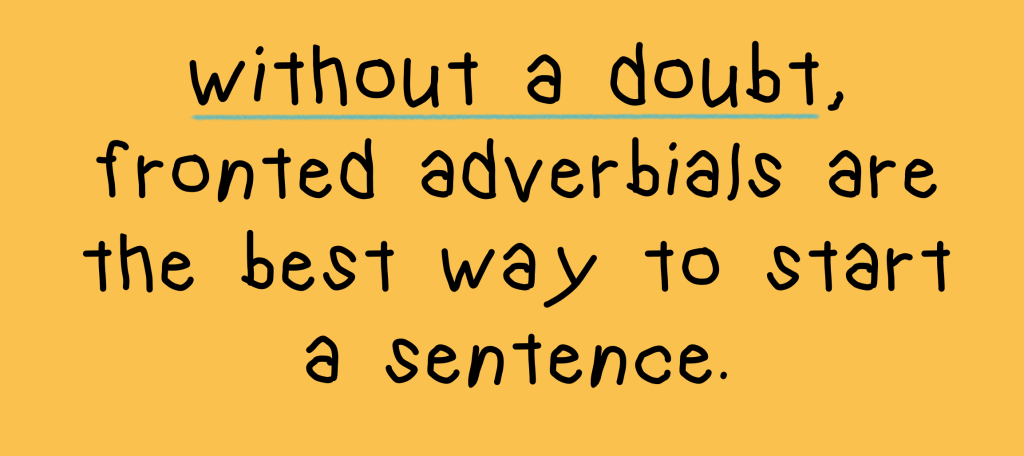
Correct: Without a sound, the cat jumped onto the wall.
Incorrect: Without a sound the cat jumped onto the wall.
A helpful way to teach this is to get children to read their sentences aloud. The natural pause they make after the fronted adverbial is exactly where the comma should go.
Practical ideas for teaching fronted adverbials
Start with drama and movement
Before you even pick up a pen, get children moving. Give them a simple action — walk across the room — and then ask them to add a fronted adverbial. How did they walk? When did they walk? Where did they walk to? This makes the concept concrete and memorable before they transfer it to paper.
Use a sentence opener toolkit
Create a class display or give children a reference card with fronted adverbial examples sorted by type. Having a bank of openers in front of them removes the blank-page problem and encourages children to experiment with different types in their writing.
Spot them in reading
Whenever you’re reading a class text, pause and ask children to spot the fronted adverbials. This builds recognition skills for the GPS paper and shows children how published authors use them to create effect. It’s a quick, low-effort activity you can weave into any guided reading session.
Uplevel boring sentences
Give children a set of plain sentences — The dog ran. She ate her dinner. He went home. — and challenge them to add a fronted adverbial to each one. This works brilliantly as a starter activity or as a quick five-minute task at the end of a lesson.
Common mistakes to watch out for
There are a few things that tend to trip children up when they’re learning about fronted adverbials.
Confusing fronted adverbials with subordinate clauses. A fronted adverbial is usually a word or short phrase, not a full clause with its own verb. Before the bell rang is a subordinate clause, while Before lunchtime is a fronted adverbial. This distinction becomes important in Upper KS2 when children meet both concepts.
Overusing the same type. Once children discover fronted adverbials, they sometimes use the same one over and over — Suddenly being a classic repeat offender. Encourage variety by challenging children to use all four types within a single piece of writing.
Forgetting that single-word adverbials count. Children sometimes think a fronted adverbial has to be a long phrase. Remind them that single words like Silently, Nervously or Outside are perfectly valid fronted adverbials too.
Ready to teach fronted adverbials with confidence?
If you’re looking for ready-made resources to support your fronted adverbials teaching, our Fronted Adverbials Worksheet Pack has everything you need. It includes identification activities, sentence writing tasks, and SPaG-style questions — all designed for KS2 and ready to use straight away.
Download the Fronted Adverbials Worksheet Pack →


Whether you’re introducing fronted adverbials for the first time in Year 3 or 4, or revising them ahead of SATs in Year 6, we hope this guide has been helpful. As always, if there’s a resource you’d like us to create, just let us know — we’re always adding to the collection.
