
-
×
 Grammar Blast Bundle - Years 5 and 6
1 × £8.00
Grammar Blast Bundle - Years 5 and 6
1 × £8.00
Grammar
What is a Relative Clause? – KS2 Guide
Relative clauses – what are they and how do you teach them?
If you’re teaching grammar in Upper KS2, relative clauses are one of those topics that children often find confusing at first – but once it clicks, it genuinely changes the way they write. They’re a Year 5 and Year 6 National Curriculum objective, they appear in the KS2 SATs GPS paper every year, and they’re one of the clearest markers of sophisticated writing at KS2 level. This guide covers what relative clauses are, the words that introduce them, and how to help children use them confidently.
So, what is a relative clause?
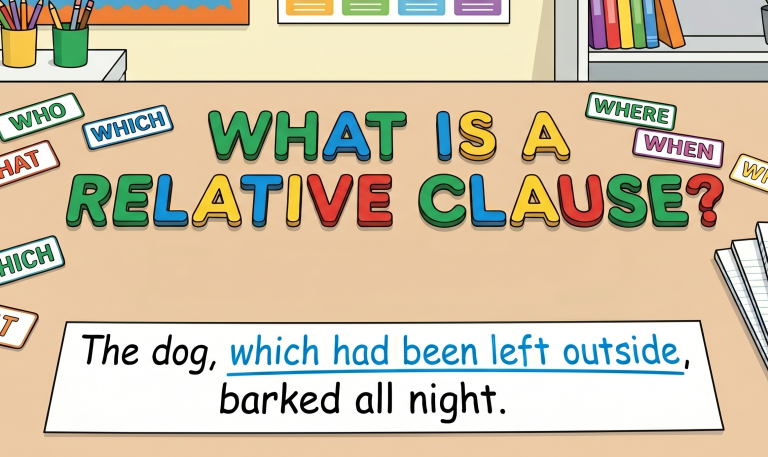
A relative clause is a type of subordinate clause that gives more information about a noun. It modifies the noun – adding detail about who or what it is – and is introduced by a relative pronoun: who, which, whose, that, where or when.
Here’s a simple example. Start with a simple sentence:
The dog barked all night.
Now add a relative clause to tell the reader more about the dog:
The dog, which had been left outside, barked all night.
The relative clause is which had been left outside. It can’t stand alone as a sentence – it depends on the main clause to make sense. And it does a specific job: it adds information about the noun dog.
The relative pronouns: who, which, whose, that, where and when
Relative clauses are introduced by one of six relative pronouns. Children need to know which one to use and when.
who – used for people
The teacher, who runs the after-school club, is called Mr Harris.
The girl, who won the race, celebrated with her friends.
which – used for things or animals
The book, which had a torn cover, was still readable.
The cat, which climbed the tree, refused to come down.
where – used for places
The park, where we used to play, has been closed.
She returned to the village where she grew up.
when – used for times
I remember the day when it snowed in April.
There are moments, when everything feels quiet, that stay with you.
whose – used to show belonging (for people or things)
The boy, whose bag was stolen, reported it to the teacher.
A house, whose roof had collapsed, stood at the end of the lane.
that – used for people or things (more informal than who or which)
The book that she recommended was brilliant.
The man that fixed our boiler charged a fortune.
Commas and relative clauses
Relative clauses that add extra information about a noun are separated from the rest of the sentence by commas. This is one of the most useful punctuation rules to teach alongside relative clauses, and it comes up regularly in the GPS paper.
The dog, which had been left outside, barked all night.
Mia, who scored the winning goal, shook the headteacher’s hand.
The village, where she had grown up, had changed completely.
The commas mark the boundaries of the relative clause. A good way to check with children: lift the relative clause out of the sentence. If what remains is still a complete, clear sentence, the clause needs commas around it.
The dog, which had been left outside, barked all night. → The dog barked all night. (complete – commas needed)
The trophy, which had gone missing, was found under the stage. → The trophy was found under the stage. (complete – commas needed)
Why do relative clauses matter in KS2?
Relative clauses are introduced in Year 5 as part of the KS2 National Curriculum. By Year 6, children are expected to use them accurately in their own writing and identify them in GPS paper questions. They’re tested in multiple ways – children might be asked to underline the relative clause in a sentence, add a relative clause to a given noun, or correctly punctuate a sentence containing a relative clause.
Beyond the test, relative clauses are a powerful writing tool. They allow children to pack more information into a single sentence, create more sophisticated noun phrases, and vary their sentence structures in ways that examiners notice. A child who uses relative clauses well in their KS2 writing assessment is demonstrating exactly the kind of grammatical control the mark scheme rewards.
How to teach relative clauses in KS2
1. Start with who and which
Who and which are the most intuitive starting points because they map clearly onto people and things – a distinction children already understand. Begin with those two before introducing whose, where and when.
Write a noun on the board:
a scientist
Ask children to tell you more about this scientist using who:
a scientist, who discovered a new planet…
a scientist, who had worked in the lab for thirty years…
a scientist, who nobody believed at first…
Then switch to an object:
a door
Now use which:
a door, which hadn’t been opened in years…
a door, which creaked whenever the wind blew…
Once children see the pattern, they can generate relative clauses quickly and confidently.
2. The noun phrase upgrade
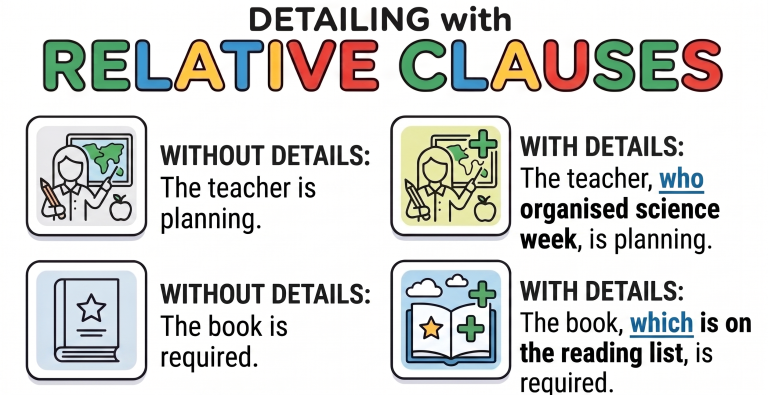
This links relative clauses directly to expanded noun phrases, which children will already know. Give them a simple expanded noun phrase and show how a relative clause can extend it further.
the old house (basic noun phrase)
the crumbling old house (expanded noun phrase with pre-modification)
the crumbling old house, which stood at the top of the hill (relative clause added)
the crumbling old house, whose windows had long since broken, stood at the top of the hill (relative clause in a full sentence)
This progression is particularly effective in Year 5 and Year 6 writing lessons because it shows children how the grammar concepts they already know connect to each other. It also produces immediate results in their independent writing.
3. Practise adding relative clauses to nouns
Give children a noun and ask them to build a relative clause around it, focusing on choosing the right relative pronoun. Start with who and which, then introduce whose, where and when as children grow in confidence.
the teacher → the teacher, who had been at the school for twenty years
the library → the library, where they had spent many afternoons
the trophy → the trophy, which had been missing for a week,
Children can then use their expanded noun phrase in a full sentence. This bridges directly from the noun phrase upgrade activity and keeps the focus on purposeful, precise writing rather than grammar for its own sake.
4. Relative clause hunt in reading
During guided reading or shared reading, ask children to hunt for relative clauses in the text. Ask them to identify the relative pronoun and the noun it’s modifying. This builds recognition skills for the GPS paper and shows children that authors use relative clauses deliberately to add precision and detail.
Relative clause challenge
A quick activity for any stage of the lesson. Give children a simple sentence:
The woman walked into the room.
Challenge them to add a relative clause using different relative pronouns:
The woman, who had travelled for days, walked into the room.
The woman walked into the room, which fell silent.
The woman walked into the room, where her family was waiting in silence.
Then ask: how does each version change what the reader imagines? This builds the habit of choosing relative pronouns with intention rather than defaulting to who or which every time.
Common mistakes to watch out for
Missing commas around the relative clause. This is the most common GPS paper error. Children who know the rule can still forget to apply it in their own writing. Regular editing tasks – asking children to go back through their work and check every relative clause has commas around it – help build the habit.
Using what as a relative pronoun. This is a very common spoken English error – the thing what I saw instead of the thing that I saw. It’s non-standard and needs correcting explicitly, particularly in Year 5 and Year 6 writing.
Overloading the noun phrase. Once children discover relative clauses, some try to stack them:the dog which was muddy which had been in the river which was near the park. Encourage them to make a choice – which detail is most important? – rather than trying to include everything.
Ready to teach relative clauses with confidence?
If you’re looking for ready-made resources to support your relative clauses teaching, our Grammar Blast Bundle – Years 5 and 6 covers relative clauses alongside the other key Upper KS2 GPS objectives – all differentiated and ready to use straight away.


This post pairs well with our expanded noun phrases guide, our subordinating conjunctions guide and our coordinating conjunctions guide – relative clauses build directly on all three concepts. As always, if there’s a resource you’d like us to create, just let us know – we’re always adding to the collection.