-
×
 Anglo-Saxons - First Enquiry Summary Lesson
1 × £0.00
Anglo-Saxons - First Enquiry Summary Lesson
1 × £0.00
Resourcefully, Topics
Anglo-Saxon Facts for KS2 (What Children Need to Know)
Teaching Anglo-Saxons for the first time – or just looking for a reliable reference point before you start planning? This post pulls together the key facts your class needs to know, organised by theme, with notes on what tends to surprise children (and teachers) and where the interesting discussions are hiding.
The content is structured around the KS2 History National Curriculum – specifically the “Britain’s settlement by Anglo-Saxons and Scots” and “Viking and Anglo-Saxon struggle for the Kingdom of England” programmes of study – so you can use it as a planning reference alongside your own scheme of work. Subject knowledge is drawn from sources including the British Museum’s Anglo-Saxon collection, Historic UK, and the Ashmolean Museum’s Anglo-Saxon archaeology resources – all worth bookmarking for your own research and as starting points for children.
Who were the Anglo-Saxons?
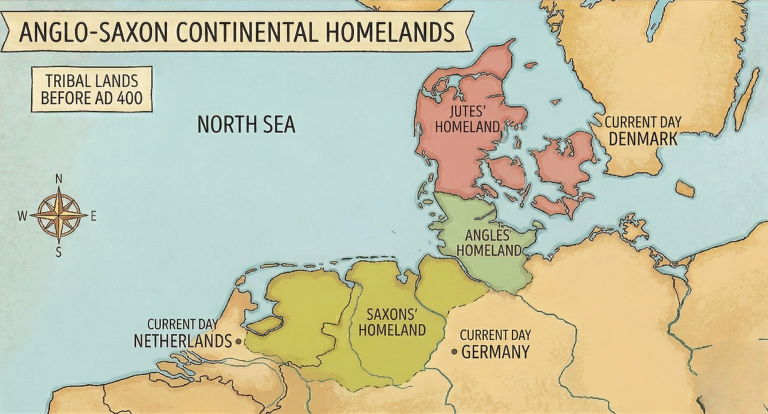
The Anglo-Saxons weren’t a single people. They were several Germanic tribes – primarily the Angles, Saxons and Jutes – who began crossing the North Sea to Britain around AD 410, when the Roman army withdrew and left Britain largely undefended.
They came from what is now northern Germany, Denmark and the Netherlands. Life in their homelands was difficult: farmland was flooding, resources were scarce, and Britain offered fertile land, established settlements and relative safety. Some groups were also invited across initially to help defend the Britons against raids from the Picts in the north – though they didn’t stay mercenaries for long.
The term “Anglo-Saxon” is one historians use to describe all these groups collectively. At the time, they would have identified far more specifically with their own tribe or kingdom. It’s worth mentioning this to children – it’s a good early lesson in how historical labels work.
The Anglo-Saxon period lasted from around AD 410 to 1066, when William the Conqueror defeated King Harold at the Battle of Hastings. That’s over 600 years – roughly the same gap as between us and the Wars of the Roses. Framing it that way tends to land well with Year 5 classes.
The Seven Kingdoms
Rather than one unified England, the Anglo-Saxons established a patchwork of competing kingdoms. At their height, there were seven: Northumbria, Mercia, East Anglia, Essex, Kent, Sussex and Wessex.
Each was ruled by its own king, and those kings frequently fought each other for land and dominance. The idea of a single “King of England” didn’t really exist until much later – Æthelstan, grandson of Alfred the Great, is generally considered the first king of a unified England, around AD 927.
The names of some of these kingdoms survive in our modern county names. Essex comes from the East Saxons. Sussex from the South Saxons. Wessex from the West Saxons. Children find this connection genuinely interesting – it’s a simple way to show that the Anglo-Saxons are still visible in the landscape around us.
Anglo-Saxon society
Anglo-Saxon society was clearly hierarchical. At the top sat the king, supported by a warrior nobility called thegns. Below them were the ceorls – free peasant farmers who made up the bulk of the population – and at the bottom were thralls, enslaved people who had no legal rights.
A person’s place in this hierarchy determined almost everything: how much land they held, what crimes they could be punished for, and how much their life was worth in law. The Anglo-Saxon legal system assigned a monetary value to each person’s life, called wergild (literally “man payment”). If you killed someone, you owed their family the appropriate wergild. The amount varied depending on the victim’s status.
This often comes up naturally when teaching crime and punishment – it’s one of those details that prompts exactly the kind of ethical discussion good history teaching should encourage. Was it ever a fair system? Who did it protect? Who did it leave exposed?
Place names: the Anglo-Saxons are still in the map
The National Curriculum specifically mentions place names as a thread running through this topic – and it’s one of the most rewarding to explore with children, because the evidence is genuinely all around them.
Anglo-Saxon settlers named the places they built and farmed, and many of those names are still in use today. A few of the most common patterns:
-
- -ing or -ingham meant “people of” – so Reading means “people of Reada”, and Birmingham means “homestead of Beorma’s people”
- -ton or -tun meant a farmstead or settlement – Brighton, Taunton, Luton
- -ley or -leigh meant a woodland clearing – Shipley, Henley, Brindley
- -ford meant a river crossing – Oxford, Hereford, Bradford
- -wick or -wich meant a farm or dwelling place – Norwich, Ipswich, Berwick
The kingdom names themselves survive too. Essex (East Saxons), Sussex (South Saxons) and Wessex (West Saxons) are the clearest examples – the compass direction plus the tribe, straightforwardly combined.
This is a rich activity for your class: give children a map of England and ask them to find local place names that might have Anglo-Saxon origins. Lesson 8 in our Anglo-Saxon Planning Unit does exactly this, using regional maps so children can focus on the area closest to their school. A simple but effective way to make the topic feel less distant.
Where and how they lived
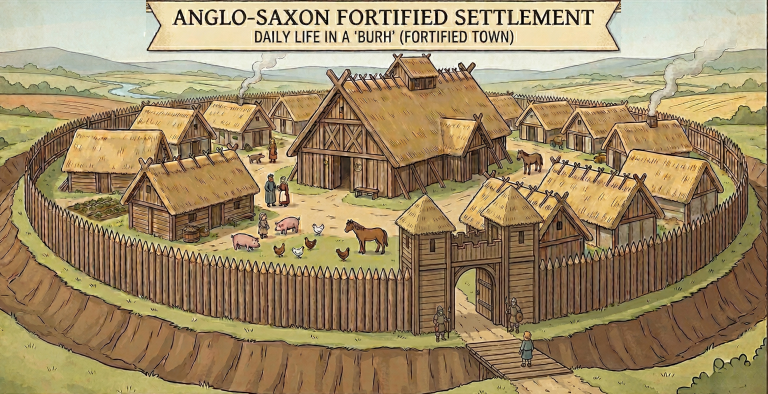
Anglo-Saxon settlements were almost entirely rural. They built small wooden villages – typically a cluster of timber-framed longhouses with thatched roofs – usually near rivers or good farmland. The villages were sometimes enclosed within a palisade fence for protection.
Inside a typical home, there was one main room shared by the whole family. A central fire provided heat and light; there were no chimneys, so smoke drifted out through gaps in the thatch. Floors were packed earth. Furniture was minimal – wooden benches, straw bedding, basic storage.
Most Anglo-Saxons were farmers. They grew wheat, rye and barley, kept animals including pigs, cows and chickens, and foraged for berries, nuts and herbs. Meat was eaten less frequently than you might expect – animals were more valuable alive – and ale was the drink of choice for everyone, including children, because river water was unsafe.
One detail children respond well to: in winter, small animals sometimes slept inside the house alongside the family. It wasn’t unusual, and it helped keep everyone warm.
Religion: from paganism to Christianity
When the Anglo-Saxons first arrived in Britain, they were pagan. They worshipped a pantheon of Germanic gods – Woden, Tiw, Thunor (Thor) and Frige among the most significant – and their beliefs were woven into everyday life, farming cycles, and burial practices.
The clearest evidence of this is still visible today: our days of the week carry the names of Anglo-Saxon gods. According to Historic UK, Tuesday comes from Tiw (god of war), Wednesday from Woden (chief of the gods), Thursday from Thunor (god of thunder) and Friday from Frige (goddess of love). Even the word Easter derives from Eostre, an Anglo-Saxon goddess of spring – according to the Venerable Bede, the monk whose writings are among our most important sources for this period.
Christianity arrived formally in AD 597, when Pope Gregory sent St Augustine to the Kingdom of Kent. Conversion spread gradually across the kingdoms over the following century, though not without setbacks – several kingdoms converted and then reverted before Christianity took permanent hold. The Dickinson College Commentaries on Bede offer an excellent overview of this process for teachers wanting to go deeper.
The shift to Christianity brought monasteries, manuscript writing and new forms of art – and gives us some of our richest evidence for what Anglo-Saxon life was actually like.
What they made and traded
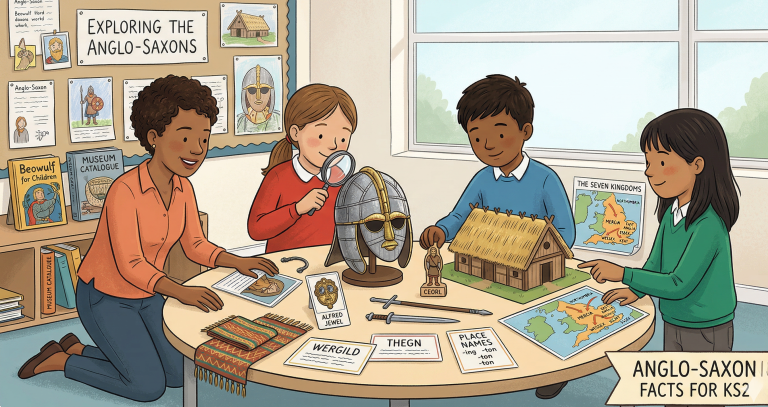
The Anglo-Saxons were skilled craftspeople – far more sophisticated than the “Dark Ages” label might suggest. They worked in metal, wood and textiles, and produced jewellery of remarkable intricacy. The Sutton Hoo helmet, the Alfred Jewel and the Staffordshire Hoard (the largest hoard of Anglo-Saxon gold ever found, discovered in 2009) are among the most famous examples of their craftsmanship.
Grave goods – objects buried with the dead – are one of our richest archaeological sources for this period. A warrior might be buried with weapons and armour. A wealthy woman might be buried with jewellery, weaving equipment and imported goods. The quality and variety of grave goods tells historians about a person’s status, trade connections and beliefs.
The British Museum’s Room 41 holds the largest and finest Anglo-Saxon collection in the world, and is worth exploring with your class online.
The “Dark Ages” – a useful myth to challenge
Children often encounter the phrase “Dark Ages” in relation to this period. It’s worth addressing directly, because historians have largely moved away from it.
The term suggests a period of decline and ignorance after the fall of Rome. In reality, the Anglo-Saxon period saw the development of the English language, the creation of extraordinary art and literature (Beowulf, the Exeter Book of riddles), the establishment of monasteries as centres of learning, and the gradual formation of England as a nation.
The Ashmolean Museum notes that by the later Anglo-Saxon period, English coinage was the major trading currency of northern Europe – hardly a picture of darkness and stagnation. Challenging the “Dark Ages” label is a good critical thinking exercise for Upper KS2, and a natural way to introduce the idea that historical interpretation changes over time.
Alfred the Great and the struggle for England
No Anglo-Saxon facts post is complete without Alfred – the National Curriculum names him explicitly, he’s a regular feature in KS2 assessments, and his story pulls together several of the topic’s biggest themes.
Alfred was King of Wessex from AD 871, at a time when Viking raids had become Viking conquest. By the late 870s, the Danes had taken most of England and Alfred himself was in hiding in the Somerset marshes. He regrouped, defeated the Danish leader Guthrum at the Battle of Edington in AD 878, and negotiated the Danelaw – a treaty that gave the Vikings control of northern and eastern England while Alfred held the south and west.
What followed was remarkable. Alfred fortified his kingdom by building a network of burhs – defended towns positioned so that no part of Wessex was more than a day’s march from one. He reformed the law code, promoted literacy, and had key texts translated from Latin into Old English so that more people could access them. He is the only English monarch ever to have been called “the Great.”
He didn’t unify England himself – that fell to his grandson Æthelstan around AD 927 – but Alfred laid the foundations. His story is a good vehicle for the concepts of cause and consequence that the curriculum asks children to develop: why did the Vikings gain so much ground? What changed when Alfred took control? Was his reputation deserved?
Children often ask whether Alfred really did burn the cakes – the famous story in which a peasant woman scolded him for letting her cakes burn while he was lost in thought. It’s almost certainly a later legend rather than historical fact, but it’s a useful moment to discuss how stories about historical figures are created and why.
What ended the Anglo-Saxon period?
The Anglo-Saxon era ended at the Battle of Hastings in October 1066. King Harold II, who had only been on the throne since January of that year, was defeated and killed by William of Normandy’s invading army. With Harold’s death, Anglo-Saxon rule of England came to an end and the Norman period began.
The transition wasn’t entirely clean – Anglo-Saxon language, law and culture left deep marks on what followed. But 1066 is the conventional endpoint, and it’s the one children need to know for the National Curriculum.
Key vocabulary for your class
These are the terms children are most likely to encounter across the topic and need to be confident with:
-
- Anglo-Saxon – collective term for the Germanic tribes (Angles, Saxons, Jutes) who settled in Britain from AD 410
- Kingdom – a territory ruled by a king; Anglo-Saxon England was divided into seven main kingdoms
- Thegn – a noble warrior who held land in exchange for military service
- Ceorl – a free peasant farmer, the most common member of Anglo-Saxon society
- Wergild – a legal payment made to compensate for killing or injuring someone; the amount depended on the victim’s status
- Pagan – someone who follows a polytheistic religion; the Anglo-Saxons were pagan before converting to Christianity
- Monastery – a religious community of monks; monasteries became important centres of learning and manuscript production
- Grave goods – objects buried with the dead, used by archaeologists to learn about a person’s life and status
- Burh – a fortified Anglo-Saxon settlement or town, developed as a defensive strategy particularly under Alfred the Great
- Alfred the Great – King of Wessex (AD 871-899), who resisted the Viking conquest, reformed Anglo-Saxon law and administration, and laid the groundwork for a unified England
- Danelaw – the area of northern and eastern England under Viking control following Alfred’s treaty with Guthrum after the Battle of Edington
- Witan – the council of advisors to an Anglo-Saxon king
Ready to start teaching?
If you’re planning your Anglo-Saxons unit and want a fully resourced, enquiry-based scheme of work ready to pick up and teach, our Anglo-Saxon Planning Unit covers 10 lessons across two enquiry questions – from who the Anglo-Saxons were and how we know about them, to how they lived and what they left behind. It includes all supporting resources and two free sample lessons to try before you buy.


National Curriculum alignment
This post covers the following statutory content from the KS2 History National Curriculum:
Britain’s settlement by Anglo-Saxons and Scots: Roman withdrawal, Anglo-Saxon invasions, settlements and kingdoms, place names and village life, Anglo-Saxon art and culture, Christian conversion
The Viking and Anglo-Saxon struggle for the Kingdom of England: Anglo-Saxon laws and justice, resistance by Alfred the Great
These are the sources used in this post and worth keeping close when you’re planning:
- British Museum: Anglo-Saxons (KS2 school resources)
- Historic UK: Days of the Week and their Anglo-Saxon origins
- Ashmolean Museum: Anglo-Saxon collection and archaeology
- Dickinson College Commentaries: Christianity in Anglo-Saxon England
- British Museum: Sutton Hoo and Europe (Room 41)
- English Place-Name Society: place name research and resources
- National Curriculum in England: History programmes of study
